All Posts By

Luis

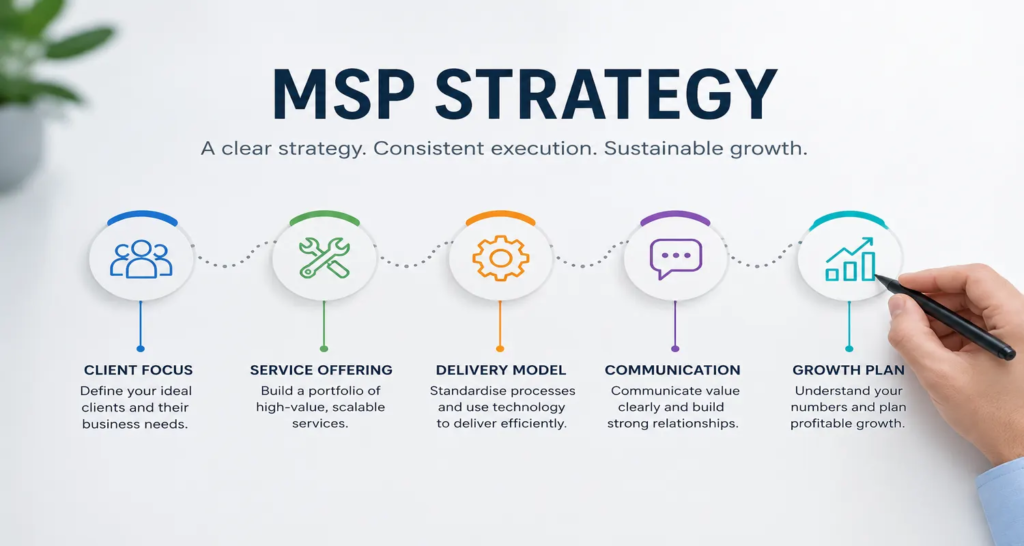
MSP strategy covering client focus, service offering, delivery, communication, and profitable growth

MSP Strategy

By MSP Insights

Building a successful Managed Service Provider is rarely about having the most talented technicians or the biggest technology stack. Instead, a successful MSP strategy aligns technical capability with a sustainable, profitable, and scalable business model.

A clear MSP strategy defines the clients you want to serve, the services you provide, how you deliver them efficiently, how you communicate value, and ultimately how the business grows.

Many MSPs begin with a highly reactive model. A client has a problem, the MSP fixes it, and everyone moves on. However, as the business grows, that approach can become a constraint. Without a clear strategy, an MSP can find itself dealing with inconsistent client environments, low-margin support, unpredictable project revenue, and increasing dependence on its founders.

SecuVeo was founded by Luis Navarro following more than 15 years spent building and growing a successful MSP. As co-founder of Totality Services, Luis helped grow the company from a small team into a highly profitable MSP serving more than 150 clients, with operations in London and Johannesburg, before the business was acquired.

One of the biggest lessons from that journey was simple: clients rarely care about technology for technology’s sake. They care about what it does for their business.

A strong MSP strategy recognizes that distinction.

Key Takeaways

Standardization supports profitability. The more technology, processes, and service delivery can be standardized, the easier the MSP becomes to operate efficiently.

Make security commercially relevant. Rather than selling individual security products, explain the business risks those products address and the outcomes they provide.

Focus on client value and retention. Structured client meetings and Security Reviews help demonstrate value, identify risks, and create opportunities for strategic conversations.

Use data to make decisions. Metrics such as recurring revenue, gross margin, service delivery cost, client retention, and revenue per employee can provide a clearer picture of business performance.

Build operational maturity. As an MSP grows, it should gradually move from reactive firefighting toward proactive account management, documented processes, strategic planning, and greater management responsibility.

What Is an MSP Strategy?

An MSP strategy is a plan for how a Managed Service Provider will create value for its clients while building a profitable and sustainable business.

Technology is obviously part of that plan. However, strategy extends far beyond the tools an MSP uses.

It should consider:

  • Which clients the MSP wants to serve
  • Which services it will provide
  • How those services will be priced
  • Which technologies will form the standard stack
  • How services will be delivered efficiently
  • How security will be incorporated
  • How clients will be managed
  • How new business will be generated
  • How profitability will be measured
  • How the company will scale

Without that structure, growth can simply create more complexity.

With it, growth has a much better chance of creating value.

Core Components of a Successful MSP Strategy

Strategy Element Reactive Approach Strategic Approach
Client Reviews Occasional catch-up meetings Structured business and Security Reviews
Pricing Cost-plus or historical pricing Pricing based on service scope, cost, value, and required margin
Security Selling individual tools such as AV or MFA Building security around risks, controls, and business outcomes
Sales Depending primarily on referrals A repeatable approach to acquisition and account growth
Operations Supporting whatever each client already uses Standardizing technologies and processes wherever practical

The objective isn’t to eliminate flexibility. Rather, it is to prevent unnecessary exceptions from becoming the operating model.

The Foundations of MSP Business Strategy

Technical expertise is essential within an MSP, but technical expertise alone doesn’t build a successful services company.

As the business grows, commercial disciplines become increasingly important.

You need to understand pricing, margins, people, sales, client retention, operational efficiency, contracts, and risk. In addition, you need to know when a client or technology no longer fits the direction of the business.

Luis wasn’t the technical founder at Totality Services. His focus was primarily on sales, marketing, client relationships, and the commercial side of the company.

That separation proved valuable.

Highly technical teams could concentrate on delivering excellent technology, while the commercial side of the business focused on translating that expertise into something clients could understand and value.

The same principle influences SecuVeo today: great technology matters, but clients still need to understand why they should care.

Operational Standardization

Consider an MSP where every client uses a different firewall, backup platform, endpoint security product, and Microsoft 365 configuration.

Every variation increases complexity.

Engineers need knowledge across more products. Troubleshooting can take longer. Automation becomes harder. Documentation becomes more complicated, and onboarding new employees requires broader training.

Standardization can reduce that burden.

For example, defining a preferred technology stack allows the MSP to develop deeper expertise around a smaller number of products. Consequently, support becomes easier to document and automate.

Standardization can also simplify sales.

When you understand your preferred client environment, you can estimate licensing, implementation, and support requirements more consistently. As a result, pricing becomes less dependent on guesswork.

The goal isn’t necessarily to make every client identical.

Instead, create a defined standard and make exceptions deliberately rather than accidentally.

Make Security Part of Your MSP Strategy

Security is now central to the relationship between MSPs and their clients.

However, that doesn’t mean every MSP needs to become a specialist cybersecurity consultancy or build its own Security Operations Center.

It does mean cybersecurity should form part of the MSP’s overall service strategy rather than existing as a collection of optional products.

For example, an MSP might establish minimum standards around:

  • Multi-Factor Authentication
  • Endpoint protection
  • Endpoint Detection and Response
  • Email security
  • Backup
  • Encryption
  • Patch management
  • Identity security
  • DNS or web protection
  • Microsoft 365 security configuration

The commercial conversation then becomes much stronger.

Instead of asking:

“Would you like to buy another security product?”

the MSP can explain:

“We’ve identified a gap against the security standard we recommend for our managed clients. Here’s the risk, why it matters, and what we recommend doing about it.”

That’s a very different conversation.

Become a Business Risk Advisor

The terminology an MSP uses matters.

Technical teams naturally think in terms of vulnerabilities, alerts, configuration, patching, endpoints, and infrastructure.

Business leaders generally think about downtime, financial loss, reputation, insurance, compliance, productivity, and operational disruption.

Therefore, a mature MSP needs to translate between the two.

A firewall isn’t valuable simply because it is a firewall. Its value comes from the business risk it helps manage.

Likewise, a backup isn’t valuable because a backup job ran successfully. Its value becomes clear when the business understands how quickly important information and systems could be recovered after an incident.

That shift in communication helps position the MSP as a strategic partner rather than simply a support provider.

Advanced MSP Strategies for Growth

Once the operational foundations are in place, the next question is growth.

For many MSPs, growth immediately means acquiring more clients.

New-client acquisition is obviously important. However, it’s only one source of growth.

Your existing client base can also create significant opportunities through additional services, security improvements, projects, cloud services, consulting, and increased user counts.

Therefore, a strong MSP strategy should consider both:

New-client acquisition and existing-client development.

Strategic Account Management

Your existing clients already know your company.

You’ve built trust, understand their environment, and have access to their technology roadmap.

However, many MSPs don’t have a consistent process for identifying and communicating recommendations.

That’s where structured account management becomes valuable.

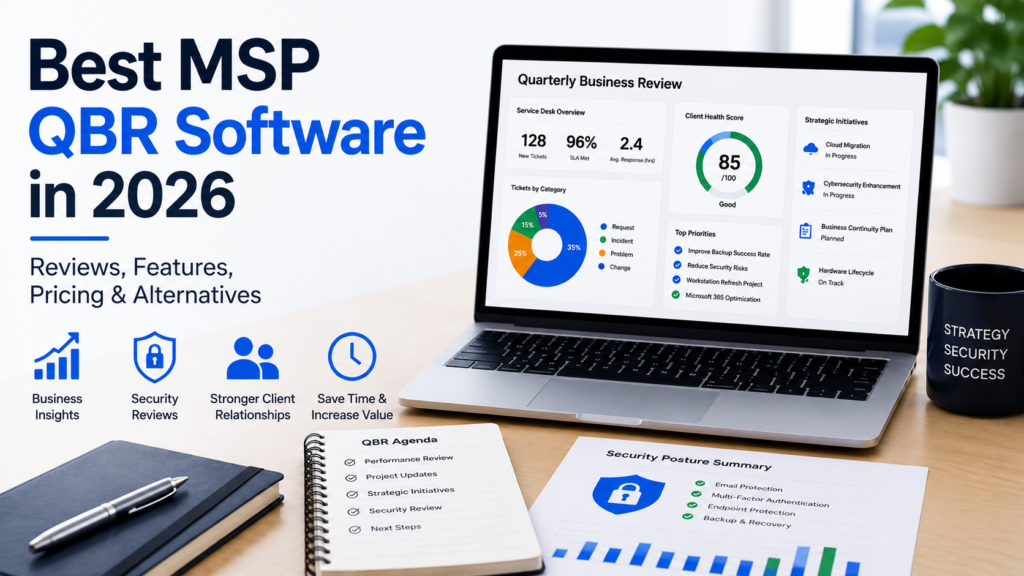
Quarterly Business Reviews (QBRs), strategic technology meetings, and Security Reviews can move the conversation beyond support tickets.

Instead of simply reporting how many tickets were closed, discuss:

  • What has changed since the previous review
  • Current business priorities
  • Outstanding technology risks
  • Security improvements
  • Infrastructure lifecycle
  • Upcoming projects
  • Budget requirements
  • Progress against previous recommendations

As a result, account management becomes proactive rather than reactive.

Pricing for Profitability

Pricing should evolve as the MSP evolves.

Labor costs change. Vendors increase prices. Clients become more complex. Security requirements expand. Meanwhile, services that were once optional can become part of the expected baseline.

Therefore, MSPs should periodically review whether their pricing still reflects the actual cost and value of the service being delivered.

Common approaches include:

Per-user pricing: Useful when service consumption broadly follows the number of people being supported.

Per-device pricing: Appropriate where endpoint or infrastructure counts are a major driver of service cost.

Tiered packages: Different service levels built around defined requirements and outcomes.

Hybrid pricing: A combination of users, devices, infrastructure, or service components.

There isn’t one pricing model that is automatically right for every MSP.

The important question is whether the model is understandable, commercially sustainable, and capable of producing the margin required to deliver a high-quality service.

Move Toward Outcomes

Clients don’t necessarily care how many technical activities an MSP performs behind the scenes.

They care about the outcome.

For example, instead of focusing only on patching activity, discuss how effective patch management reduces exposure to known vulnerabilities.

Similarly, don’t talk only about backup jobs. Discuss recovery objectives and the organization’s ability to restore critical information after an incident.

This doesn’t mean eliminating technical detail. Instead, it means connecting that detail to something commercially meaningful.

Commercializing Security Through Structured Reviews

Security Reviews can serve several purposes simultaneously.

First, they help identify weaknesses in a client’s security posture.

Second, they demonstrate the work and value provided by the MSP.

Finally, they create a structured opportunity to discuss legitimate improvements.

However, many Security Reviews become too technical.

A client may receive dozens of pages of information but still struggle to answer the most important questions:

What’s wrong?

Why does it matter?

What do you recommend?

What should we do next?

A good Security Review should make those answers clear.

The “Why It Matters” Framework

Consider MFA.

Simply telling a client that MFA should be enabled may not be enough. The client might see additional authentication as inconvenient.

Instead, explain the underlying issue.

Passwords can be stolen or compromised. MFA adds another verification step, which can make it significantly harder for someone with a stolen password to access an account.

Now the client understands why the control matters.

The same approach can be used throughout a Security Review:

  1. Current State: Where are we today?
  2. The Gap: What is missing?
  3. The Risk: Why does this matter to the business?
  4. The Recommendation: What should be done?
  5. The Decision: What has the client decided?

This turns a technical finding into a business conversation.

Creating Accountability

Recommendations also need outcomes.

Suppose an MSP identifies an important security gap, explains the risk, provides a recommendation, and the client decides not to proceed.

That decision should be documented.

Doing so creates a clear record of what was recommended and what the client decided at that point in time.

However, risk acknowledgement shouldn’t be treated as a substitute for appropriate contracts, insurance, professional advice, or the MSP’s own security obligations.

Its primary purpose is clarity and accountability.

Moreover, the record becomes valuable at the next review. The MSP can revisit the recommendation, explain whether the risk has changed, and ask the client to reconsider.

This structured approach to Security Reviews is one of the ideas behind SecuVeo.

Build an Investment-Ready MSP

Even if you have no plans to sell your MSP, building it as though somebody might want to acquire it can be a useful discipline.

Why?

Because many of the characteristics that can make an MSP attractive to a buyer are also characteristics of a healthy business.

For example:

  • Predictable recurring revenue
  • Healthy margins
  • Strong client retention
  • Low customer concentration
  • Appropriate contracts
  • Standardized service delivery
  • Documented processes
  • Capable management
  • Limited founder dependency

Improving these areas can make the business stronger regardless of whether a transaction ever takes place.

Focus on High-Quality Recurring Revenue

Not all recurring revenue is equally attractive.

Imagine two contracts generating similar revenue. One runs efficiently on your standard technology stack, while the other generates constant support issues and requires several non-standard products.

The headline revenue may look similar.

The economics aren’t.

Therefore, your MSP strategy should consider the quality and profitability of recurring revenue, not simply the total amount.

Reduce Owner Dependency

Founder dependency creates a natural ceiling.

If the owner needs to approve every proposal, handle every important client meeting, resolve every escalation, and make every operational decision, growth will eventually become constrained.

Processes can help.

For example, standardized client reviews allow account managers to follow a consistent framework rather than relying entirely on the founder’s personal knowledge.

Likewise, documented sales, onboarding, service delivery, and escalation processes make it easier for other people to take responsibility.

Over time, the business becomes less dependent on individual personalities and more dependent on systems.

Keep an Eye on EBITDA

Revenue growth is easy to celebrate.

Profitability deserves equal attention.

EBITDA can provide a useful view of underlying operating performance, although it should be considered alongside other metrics.

For an MSP, those may include:

  • Gross margin
  • MRR
  • Client retention
  • Revenue per employee
  • Service delivery cost
  • Effective Hourly Rate
  • Client concentration
  • Sales pipeline
  • Cash generation

Ultimately, strategy needs to show up in the financial performance of the business.

If revenue is growing rapidly while margins continually decline, something needs attention.

Common MSP Strategy Mistakes

Even a good strategy can fail through poor execution.

Several problems repeatedly appear as MSPs grow.

Taking On the Wrong Clients

Early-stage MSPs often accept almost any client because revenue matters.

That’s understandable.

However, as the company grows, some clients can become increasingly difficult to support because they refuse to replace outdated infrastructure, adopt basic security controls, or move toward the MSP’s standards.

At that point, the MSP has choices.

It can help the client modernize, reprice the service to reflect the additional complexity, or decide that the relationship is no longer commercially appropriate.

The important thing is to make that decision deliberately.

Over-Tooling

MSP vendors constantly release new products.

Some can create significant value. Others simply duplicate functionality already present in the stack.

Every additional tool brings licensing costs, training, management, integration, documentation, and support requirements.

Therefore, before adding another platform, ask:

What specific problem does this solve?

Will it improve service delivery?

Will it reduce risk?

Will it reduce operating cost or create additional revenue?

If the answer isn’t clear, adding another product may simply create more complexity.

Fear of Selling

MSP owners sometimes feel uncomfortable discussing additional security spending because they don’t want every client meeting to feel like a sales pitch.

That’s understandable.

However, there is an important difference between unnecessary upselling and making a professional recommendation.

If you genuinely believe a client has an important security weakness, explaining that weakness isn’t aggressive selling.

It’s part of your role as their technology advisor.

Present the risk clearly, explain your recommendation, provide the commercial information required to make a decision, and then let the client decide.

The SecuVeo Perspective: Real-World Application

SecuVeo wasn’t created from a theoretical idea of how MSPs should operate.

It came from experience building one.

During more than 15 years of growing Totality Services, one recurring challenge was taking complex technical information and turning it into something commercially meaningful for clients.

Security Reviews are a perfect example.

A client doesn’t necessarily need another 40-page technical document.

They need to understand:

Where are we now?

What are the risks?

What has changed?

What do you recommend?

What happens next?

When those questions are answered clearly, decision-making becomes easier.

Standardize the Security Review Process

If the quality and content of a Security Review depend entirely on the individual performing it, consistency becomes difficult.

One person may focus heavily on endpoint security. Another may concentrate on Microsoft 365. Someone else may emphasize backup.

A standardized framework helps ensure that important areas are reviewed consistently.

Furthermore, standardization makes it easier to train Account Managers and vCIOs, compare progress over time, and deliver a consistent experience across the client base.

This is where a platform such as SecuVeo can support the wider MSP strategy by turning Security Reviews into a structured, repeatable workflow.

Future-Proofing Your MSP Strategy

The managed-services market will continue to change.

Cybersecurity requirements are increasing. Compliance obligations are evolving. AI is changing workflows. Clients are becoming more dependent on cloud services, while insurers and other third parties increasingly influence security requirements.

Therefore, an MSP strategy can’t remain static indefinitely.

Compliance as an Opportunity

Some clients need to meet specific security or compliance requirements because of their industry, customers, contracts, insurers, or regulatory environment.

MSPs don’t necessarily need to become legal or compliance specialists.

However, understanding the technology controls associated with the sectors they serve can create additional value.

For MSPs with a strong vertical focus, this can also become a meaningful differentiator.

AI and Automation

Automation has been part of managed services for years, but AI is creating additional opportunities.

Routine administrative work, reporting, data analysis, documentation, and other repetitive tasks may increasingly be automated or accelerated.

However, the objective shouldn’t simply be to automate everything.

Use technology to reduce low-value manual work so employees have more time for activities where human judgment matters.

That might include:

  • Strategic client conversations
  • Complex troubleshooting
  • Security recommendations
  • Account management
  • Consulting
  • Business planning

As a result, automation can support both efficiency and a better client experience.

Frequently Asked Questions

How Often Should I Update My MSP Strategy?

A formal annual strategic review is a sensible starting point for many MSPs. However, tactical areas such as pricing, vendor performance, security requirements, and sales performance may need to be reviewed more frequently.

The important thing is to avoid creating a strategy once and then ignoring it.

What Is the Most Important KPI for an MSP Business Strategy?

There isn’t one KPI that adequately measures an MSP.

MRR tells you about recurring revenue but not necessarily profitability. EBITDA provides insight into operating performance but doesn’t explain individual client economics. Revenue per employee can indicate efficiency but needs context.

Therefore, use a combination of metrics that reflects revenue, profitability, service delivery, client retention, and growth.

Should I Hire an MSP Strategy Consultant?

An experienced outside perspective can be valuable, particularly when an MSP reaches a stage of growth its leadership team hasn’t experienced before.

However, choose carefully.

Look for someone who understands the economics and operational realities of an MSP rather than someone offering generic business advice.

How Do I Convince Clients to Pay for Security Projects?

Start by making the risk understandable.

Explain the current situation, the business impact, your recommendation, the investment required, and what could happen if the client decides not to proceed.

That creates an informed business decision rather than a purely technical discussion.

Can I Scale My MSP Without Standardizing My Stack?

Yes, but unnecessary variation generally makes scaling more difficult.

Standardization can improve training, automation, troubleshooting, documentation, procurement, and pricing.

However, the objective shouldn’t be standardization for its own sake. Maintain flexibility where a client’s genuine requirements justify it.

What Role Does SecuVeo Play in an MSP Strategy?

SecuVeo helps MSPs standardize and automate the Security Review process.

It provides a repeatable way to review security, communicate risks clearly, demonstrate value, track client decisions, and identify legitimate opportunities for security improvements.

As a result, Security Reviews can become part of the MSP’s broader account-management and growth strategy rather than an isolated technical exercise.

Is Per-User or Per-Device Pricing Better for Growth?

Neither model is automatically better.

Per-user pricing can work particularly well where users are the main driver of service consumption. Conversely, per-device pricing may be appropriate where endpoint or infrastructure counts more closely reflect the MSP’s cost.

Some providers use a hybrid approach.

The best model is the one that clients can understand and that accurately reflects the cost, scope, and value of the service being provided.

How Should I Handle a Client Who Refuses Security Recommendations?

First, make sure the recommendation and associated business risk have been explained clearly.

If the client still declines, document the recommendation and their decision through your established process.

For particularly significant risks, the MSP may also need to consider whether continuing to support the client is consistent with its contractual obligations, insurance requirements, security standards, and risk appetite.

Building a Better MSP

Ultimately, a strong MSP strategy is about creating a business that becomes more capable as it grows rather than simply more complicated.

Standardize where it makes sense. Understand your numbers. Develop your people. Build predictable sales and account-management processes. Make cybersecurity commercially understandable. Document recommendations and client decisions. Above all, make sure growth improves the quality of the business rather than simply increasing its size.

For Luis, many of these lessons came from more than 15 years of building Totality Services from a small team into a successful MSP before its acquisition.

SecuVeo takes one part of that experience and turns it into a repeatable process: helping MSPs deliver consistent Security Reviews, demonstrate value, communicate security risks clearly, and turn genuine recommendations into informed client decisions.

Technology will continue to change.

The MSPs that build strong businesses around it will be the ones best positioned to grow.
MSP solutions for modern Managed Service Providers

MSP Solutions

By MSP Insights

The best MSP solutions help Managed Service Providers deliver better service without adding unnecessary complexity. As MSPs grow, they need technology, processes, automation, and commercial systems that allow their teams to support more clients while maintaining security, consistency, and service quality.

However, adding more tools is not necessarily the answer.

A modern MSP may already operate a PSA, RMM platform, documentation system, security stack, backup platform, Microsoft 365 environment, ticketing workflows, reporting tools, and numerous vendor portals.

Therefore, the challenge is increasingly about making those systems work together effectively.

The right MSP solutions should reduce manual work, create consistency, improve visibility, strengthen security, and make it easier for clients to understand the value their MSP provides.

Key Takeaways

Successful MSPs increasingly use technology and processes to create a repeatable service model.

In particular:

  • Standardization matters. Supporting a controlled technology stack reduces complexity and improves service consistency.
  • Automation improves efficiency. Repetitive administrative work should be automated wherever practical.
  • Security needs structure. MSPs need repeatable processes for assessing and communicating client security requirements.
  • Integration reduces duplication. MSP solutions should share useful information rather than creating more isolated data.
  • Client communication matters. Technical information becomes more valuable when clients understand what it means.
  • Operational visibility is essential. MSP leaders need reliable information about clients, services, risks, agreements, and performance.
  • The best tools solve specific problems. More software does not automatically create a better MSP.

Ultimately, technology should make the MSP easier to operate, not harder.

What Are MSP Solutions?

MSP solutions are the platforms, tools, services, and processes Managed Service Providers use to manage their own operations and deliver services to clients.

They cover almost every part of the MSP business.

Area Typical MSP Solution
Service management PSA platform
Endpoint management RMM platform
Documentation IT documentation platform
Security Endpoint, identity, email, and network security
Backup Cloud and endpoint backup platforms
Client reviews Security Review and reporting platforms
Billing PSA and accounting integrations
Automation Workflow and integration tools
Microsoft services Microsoft 365 management
Reporting Operational and client reporting platforms

However, the value of these systems depends on how the MSP uses them.

An MSP can have excellent individual products and still operate inefficiently if information remains fragmented across multiple systems.

Consequently, MSP owners should evaluate solutions based on the operational outcome they create rather than the length of their feature lists.

Building an Effective MSP Technology Stack

Most established MSPs have accumulated technology over many years.

A new requirement appears, so another product gets added.

A large client needs something different, so the MSP supports an exception.

An engineer prefers another platform, so the stack expands again.

Eventually, the MSP may support dozens of products that perform similar functions.

That creates complexity.

Engineers need broader product knowledge. Documentation becomes harder to maintain. Automation becomes more complicated. Procurement takes longer. Security policies vary between clients.

Therefore, one of the most important principles when selecting MSP solutions is standardization.

The objective should not necessarily be to use one vendor for everything. Instead, MSPs should establish a preferred solution for each major service category.

For example, an MSP might define preferred platforms for:

  • Endpoint protection
  • Endpoint Detection and Response
  • Email security
  • Cloud backup
  • DNS filtering
  • Password management
  • Identity protection
  • Security awareness training
  • RMM
  • PSA
  • Documentation
  • Security Reviews

Clients then receive a more consistent service while engineers work within a familiar environment.

Why Standardization Matters

Standardization affects almost every area of an MSP.

First, it makes training easier.

Engineers who repeatedly work with the same technologies develop deeper expertise. As a result, they can often diagnose problems faster.

Second, standardization improves automation.

Creating automated processes across three endpoint platforms is considerably easier than creating them across ten.

Third, it improves security.

The MSP can define a standard configuration and apply it consistently across clients rather than maintaining numerous variations.

Finally, standardization makes client onboarding easier because the destination environment is already defined.

There will always be exceptions. However, they should remain exceptions rather than gradually becoming the standard operating model.

PSA Platforms as the Operational Core

For many MSPs, the Professional Services Automation platform sits at the center of the business.

The PSA commonly contains information about:

  • Clients
  • Contacts
  • Agreements
  • Products
  • Recurring billing
  • Tickets
  • Projects
  • Time entries
  • Procurement
  • Account management

Therefore, the quality of the data inside the PSA matters enormously.

Poor agreement data can lead to incorrect billing.

Missing products can mean services never reach the client’s invoice.

Inconsistent client information can also make integrations unreliable.

Consequently, MSPs should treat their PSA as operational infrastructure rather than simply a ticketing system.

When evaluating additional MSP solutions, integration with the PSA should also be an important consideration.

If a new platform requires staff to recreate information that already exists elsewhere, the MSP should question whether that workflow can be improved.

RMM and Endpoint Management

Remote Monitoring and Management platforms remain another fundamental part of the MSP technology stack.

An RMM platform allows an MSP to manage large numbers of endpoints centrally.

Typical functions include:

  • Device monitoring
  • Patch management
  • Remote access
  • Scripting
  • Software deployment
  • Alerting
  • Hardware monitoring
  • Automated remediation

However, poorly configured RMM platforms can generate enormous amounts of unnecessary noise.

If every minor event creates a ticket, technicians eventually begin ignoring alerts.

Therefore, successful MSPs continuously tune monitoring policies.

The objective is not to generate the largest possible number of alerts. Instead, it is to identify the events that genuinely require action.

Automation as an MSP Solution

Automation offers MSPs one of the clearest opportunities to improve operational efficiency.

Many activities still performed manually can either be completely automated or significantly streamlined.

For example:

  • User onboarding
  • User offboarding
  • Device configuration
  • Software deployment
  • Patch management
  • Ticket categorization
  • Agreement updates
  • Report generation
  • Client notifications
  • Billing checks
  • Security monitoring

Even small automations can become significant at scale.

Saving five minutes on a process may seem insignificant. However, if technicians perform that process hundreds of times every month, the accumulated saving becomes substantial.

Nevertheless, automation should solve a genuine operational problem.

Automating a bad process simply allows the MSP to perform the wrong activity faster.

Therefore, MSPs should simplify the underlying workflow before automating it.

Cybersecurity MSP Solutions

Cybersecurity now represents a significant part of the modern MSP service stack.

Clients increasingly expect their MSP to manage much more than antivirus software and firewalls.

A modern security stack may include:

  • Endpoint protection
  • Endpoint Detection and Response
  • Identity protection
  • Multifactor authentication
  • Email security
  • DNS filtering
  • Cloud backup
  • Security awareness training
  • Vulnerability management
  • Microsoft 365 security
  • Security monitoring

However, deploying security products is only part of the job.

MSPs also need a way to understand which protections each client has, where gaps exist, which recommendations have been made, and what clients have decided.

That creates a different challenge.

It is not simply a technical challenge. It is also a communication and accountability challenge.

Security Reviews as Part of the MSP Service Model

Security changes continuously.

A client that had an appropriate security environment two years ago may have significant gaps today.

The business may have grown. Employees may work differently. Microsoft may have introduced new capabilities. Threats may have evolved. Insurance requirements may also have changed.

Therefore, security should not become a set and forget service.

Regular Security Reviews allow the MSP to reassess the client’s environment and identify areas requiring attention.

A structured review should answer several straightforward questions:

What protection does the client currently have?

Where are the gaps?

What should change?

Why does it matter?

What does the MSP recommend?

What has the client approved or declined?

The final point is particularly important.

Recommendations should not disappear into meeting notes or spreadsheets.

Both the MSP and the client benefit from having a clear record of what was recommended and what decision followed.

Making Security Understandable

Technical teams often identify risks long before clients understand them.

An engineer may know exactly why a particular security control matters.

However, telling a Managing Director that a configuration does not meet a particular technical standard may not produce a decision.

The conversation becomes much more useful when the MSP explains the business impact.

Instead of saying:

“You need to implement this because it is best practice.”

The MSP can explain:

“Without this protection, a compromised password could allow an attacker to access company information. This control significantly reduces that risk.”

The technical recommendation has not changed.

However, the client can now understand the reason behind it.

This principle should apply across MSP solutions. Technology creates greater value when the client understands the outcome it provides.

Client Reporting Solutions

Reporting is another area where MSPs often struggle.

Modern technology platforms generate enormous quantities of data.

However, clients rarely need all of it.

A 40 page technical report may contain extensive information while communicating very little to a business owner.

Effective client reporting should therefore prioritize decisions over data.

For example, clients generally need to understand:

  • What is working well
  • What needs attention
  • What risks exist
  • What the MSP recommends
  • What decisions need to be made
  • What projects should be planned
  • What budget may be required

The technical evidence still matters.

However, it should support the conversation rather than dominate it.

Microsoft 365 Management

Microsoft 365 has become central to many MSP client environments.

As a result, MSPs increasingly need effective ways to manage:

  • Users
  • Licensing
  • Multifactor authentication
  • Conditional Access
  • Email security
  • SharePoint
  • OneDrive
  • Teams
  • Device policies
  • Identity
  • Security configurations

The challenge is scale.

Checking one Microsoft tenant manually may be manageable. Checking hundreds becomes much more difficult.

Therefore, MSPs should look for ways to automate monitoring and identify meaningful exceptions.

Microsoft also publishes extensive guidance through its official Microsoft Learn resources, which MSPs can use when reviewing configuration and security requirements.

Backup and Business Continuity Solutions

Backups remain one of the most important services an MSP provides.

However, simply deploying backup software is not enough.

MSPs need confidence that backups actually work.

That means monitoring:

  • Backup success
  • Backup failures
  • Storage capacity
  • Retention
  • Recovery points
  • Restore testing
  • Offsite copies
  • Microsoft 365 backups
  • Disaster recovery procedures

Most importantly, MSPs should test recovery.

A backup that has never been restored is still an assumption.

Therefore, backup strategy should focus on recoverability rather than simply successful backup jobs.

Documentation Solutions

Good documentation reduces dependency on individual employees.

Client environments should not exist primarily inside the memory of one senior engineer.

Instead, the MSP should document important information consistently.

That might include:

  • Network information
  • Devices
  • Vendors
  • Applications
  • Administrative procedures
  • Client contacts
  • Escalation information
  • Recovery procedures
  • Standards
  • Exceptions

Documentation also needs ownership.

Outdated documentation can sometimes be more dangerous than missing documentation because engineers assume the information is accurate.

Consequently, MSPs should make documentation updates part of normal operational workflows rather than treating them as occasional administrative projects.

Integration Between MSP Solutions

Integration is becoming increasingly important as MSP technology stacks expand.

Consider a typical client.

Their agreement information may exist in the PSA.

Microsoft 365 contains the user and identity information, while the RMM provides visibility into their devices.

Meanwhile, the endpoint security platform maintains another view of those devices, and backup information sits in a separate system.

Security recommendations may live somewhere else entirely, perhaps in a spreadsheet or review document.

Finally, billing information exists across the PSA and accounting platform.

Each system contains part of the picture.

The opportunity is to connect those sources so employees spend less time manually comparing information.

Therefore, when assessing new MSP solutions, MSPs should ask:

What information does this system already know?

What information does it need?

Can that information come automatically from an existing source?

Every unnecessary duplicate data entry creates another opportunity for inconsistency.

AI Within MSP Solutions

Artificial intelligence will increasingly influence MSP operations.

However, the greatest opportunities are unlikely to come from simply adding an AI chatbot to every system.

AI becomes valuable when it reduces genuine manual effort or helps people make better decisions.

Potential applications include:

  • Ticket categorization
  • Ticket summarization
  • Documentation
  • Security analysis
  • Product matching
  • Client reporting
  • Knowledge retrieval
  • Alert prioritization
  • Proposal preparation
  • Data analysis

For example, an AI system may identify a product within PSA billing data and suggest which security service category it belongs to.

That can save administrative time.

However, human review remains important.

MSPs operate complex client environments, and automated conclusions should not automatically become client recommendations without appropriate oversight.

Selecting the Right MSP Solutions

The MSP software market is crowded.

Almost every platform promises automation, efficiency, better security, and improved profitability.

Therefore, MSPs need a disciplined way to evaluate new technology.

Before purchasing another platform, ask:

What specific problem are we solving?

If the answer is unclear, the product may not be necessary.

Next ask:

How often does this problem occur?

Solving a task that consumes hundreds of hours each month has very different value from automating something performed twice a year.

Then consider:

Does an existing platform already solve this?

MSPs frequently underuse software they already own.

Finally:

Will employees actually use it?

A technically excellent system provides little value if adoption is poor.

The best MSP solutions fit naturally into existing workflows and remove friction rather than creating another administrative layer.

Avoiding Tool Sprawl

Tool sprawl has become a genuine problem for MSPs.

Over time, subscriptions accumulate.

Some overlap. Others no longer provide meaningful value.

Meanwhile, individual teams may use products that management barely knows exist.

Therefore, MSPs should periodically review their technology stack.

For each product, consider:

  • What does it do?
  • Who uses it?
  • Which clients use it?
  • What does it cost?
  • Does another platform provide the same functionality?
  • Is it integrated with the wider stack?
  • Would removing it create a meaningful problem?

This process is not simply about reducing software expenditure.

It is about reducing complexity.

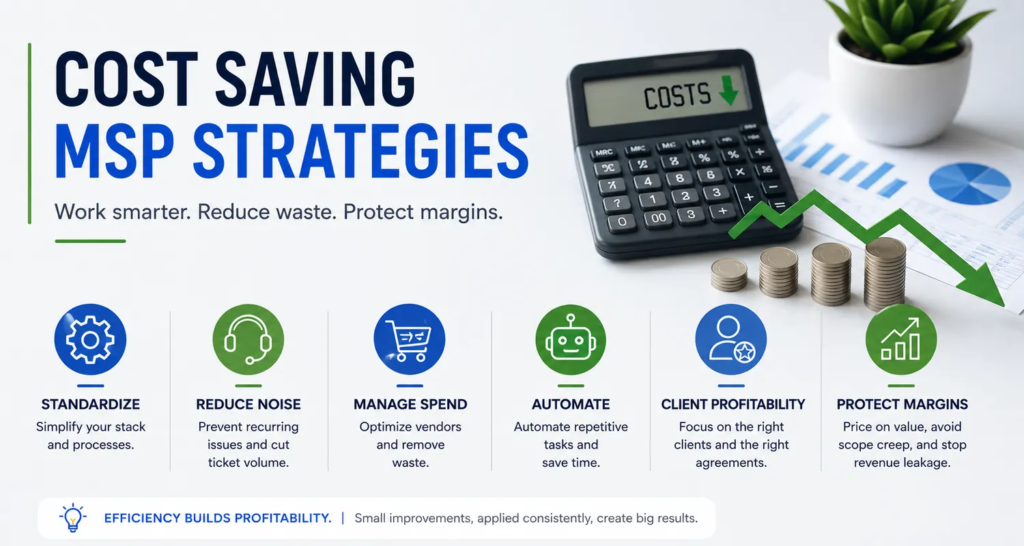
For a deeper examination of operational efficiency and expenditure, our Cost Saving MSP Strategies guide covers that subject specifically.

MSP Solutions and the Client Experience

Technology ultimately needs to improve the client experience.

Clients rarely care which PSA their MSP uses.

They do not choose an MSP because its RMM platform has a particular scripting engine.

Instead, they notice outcomes.

Are issues resolved quickly?

Does the MSP communicate clearly?

Is their environment secure?

Do they understand upcoming technology requirements?

Can they plan their IT budget?

Does their MSP identify problems before those problems become emergencies?

Therefore, the best internal MSP solutions are often invisible to the client.

The technology enables the MSP team to provide a better experience.

SecuVeo as an MSP Solution for Security Reviews

One area that often remains fragmented is the Security Review process.

MSPs may have excellent technical products but still manage reviews through spreadsheets, Word documents, PowerPoint presentations, PSA notes, or manually assembled reports.

That makes standardization difficult.

SecuVeo was created specifically to address that problem.

Founded by Luis Navarro, who previously spent 15 years building the London based MSP Totality Services before the business was acquired, SecuVeo applies practical MSP experience to the Security Review process.

The platform helps MSPs standardize reviews, identify security gaps, communicate recommendations clearly, track client decisions, and connect technical findings with commercial conversations.

The objective is not to replace the MSP’s PSA, RMM, or security products.

Instead, SecuVeo provides a structured layer for bringing relevant information together into a repeatable Security Review process.

That distinction matters.

The strongest MSP technology stacks are not necessarily those with the most products.

They are the ones where each product has a clear purpose.

Building a Connected MSP Technology Environment

As the MSP industry continues to mature, integration and standardization will become increasingly important.

MSPs already have access to enormous amounts of data.

The next challenge is turning that data into useful information.

PSA systems know what clients purchase.

Microsoft 365 knows how users and identities are configured.

Security platforms know which protections are deployed.

RMM platforms know what devices exist.

Backup platforms know whether data is protected.

Meanwhile, Security Reviews can bring those different perspectives together into a conversation the client understands.

The MSP of the future will increasingly connect these systems rather than operate them independently.

As a result, technicians should spend less time collecting information and more time acting on it.

Frequently Asked Questions About MSP Solutions

What Are MSP Solutions?

MSP solutions are the software platforms, services, security technologies, automation systems, and operational processes Managed Service Providers use to manage clients and operate their businesses.

Common examples include PSA platforms, RMM tools, documentation systems, backup platforms, cybersecurity products, Microsoft 365 management tools, and Security Review platforms.

What Software Does an MSP Need?

Most MSPs require a core set of systems covering service management, endpoint management, documentation, security, backup, billing, and client management.

However, the exact technology stack depends on the MSP’s size, client profile, service offering, and operational model.

The objective should be to create an integrated stack rather than simply accumulating products.

Why Is Standardization Important for MSPs?

Standardization reduces operational complexity.

When clients use a consistent technology stack, technicians develop deeper expertise, automation becomes easier, onboarding becomes more predictable, and security configurations can be applied more consistently.

Some exceptions will always exist. Nevertheless, MSPs should generally establish preferred technologies and processes.

How Can MSPs Use Automation?

MSPs can automate repetitive processes such as user onboarding, software deployment, patch management, reporting, ticket categorization, billing checks, monitoring, and client notifications.

However, automation works best when the underlying process is already well designed.

How Should MSPs Evaluate New Software?

Start with the problem rather than the product.

Identify what the MSP needs to improve, estimate how much time or risk the current problem creates, and determine whether an existing platform can already solve it.

Then evaluate integration, usability, security, cost, and expected operational benefit.

How Can MSPs Improve Security Reviews?

Security Reviews should follow a consistent process that identifies existing protections, highlights gaps, explains business risks, records recommendations, and tracks client decisions.

The objective is to transform technical information into clear actions that clients can understand.

Can AI Improve MSP Operations?

Yes. AI can help MSPs categorize tickets, summarize information, analyze data, identify patterns, create reports, retrieve knowledge, and automate repetitive administrative work.

However, MSPs should retain appropriate human oversight, particularly when AI generated information could influence security or client decisions.

Final Thoughts

There is no single collection of MSP solutions that will suit every Managed Service Provider.

However, the principles behind a strong technology stack are remarkably consistent.

Standardize where practical.

Integrate systems where useful.

Automate repetitive work.

Maintain accurate data.

Reduce unnecessary complexity.

Make security measurable.

And, most importantly, use technology to help people make better decisions.

The objective should never be to own the largest possible collection of MSP software.

Instead, build an environment where each platform has a clear purpose and contributes to a consistent operating model.

Because ultimately, the best MSP solutions do not create more work for the MSP.

They remove it.

MSP customer retention strategies for stronger client relationships

MSP Customer Retention

By MSP Insights

Strong MSP customer retention is one of the foundations of a successful Managed Service Provider. Winning new clients matters, but sustainable growth becomes much harder if existing clients are continually leaving. MSPs that retain clients can build recurring revenue, develop deeper relationships, improve operational stability, and grow without constantly replacing lost business.

However, retention is about much more than keeping a contract in place.

Clients stay when they continue to understand the value their MSP provides. They trust the advice they receive, feel supported when problems occur, and believe their provider understands where their business is heading.

As a result, the strongest client relationships tend to move beyond technical support.

The MSP becomes a trusted business partner.

Key Takeaways

Successful MSP customer retention usually comes from doing several things consistently well:

  • Deliver reliable service. The fundamentals still matter. Clients expect responsive support and dependable technology.
  • Communicate proactively. Do not make tickets the only reason clients hear from you.
  • Make your value visible. Much of an MSP’s best work happens behind the scenes, so clients need help understanding it.
  • Understand the client’s business. Technology recommendations become more valuable when they support real business objectives.
  • Standardize the client experience. Every client should receive a consistent level of strategic attention.
  • Review security regularly. Security Reviews create valuable conversations about risk, priorities, and future investment.
  • Track recommendations and decisions. A clear record creates accountability for both the MSP and the client.
  • Watch for early warning signs. Retention problems should be addressed before contract renewal.

Ultimately, clients are more likely to stay when they consistently understand why their MSP matters.

What Is MSP Customer Retention?

MSP customer retention refers to an MSP’s ability to maintain relationships with existing clients over time.

At its simplest, it can be measured by looking at how many clients remain with the MSP during a particular period.

However, retention is not purely contractual.

A client can technically remain under contract while the relationship deteriorates.

They may stop attending review meetings. Senior decision makers may become less engaged. Complaints may increase. Projects may stall. Recommendations may repeatedly go unanswered.

Those signals matter because the relationship may already be weakening long before the client formally leaves.

Therefore, MSPs should think about retention as the health of the relationship, not simply the absence of cancellation.

Why MSP Customer Retention Matters

Recurring revenue is one of the defining characteristics of the MSP business model.

When clients remain for many years, the MSP can build predictable revenue around those relationships.

Furthermore, the commercial value of the relationship can increase over time.

The MSP learns more about the client’s environment.

Technicians become familiar with its users and applications.

Account managers understand its priorities.

Security recommendations become more relevant.

Projects can be planned further ahead.

As trust grows, the client may also become more comfortable discussing future technology investments.

Conversely, high client turnover creates additional pressure.

Sales teams need to replace lost recurring revenue before the MSP can grow. Engineers repeatedly onboard and offboard environments. Management spends time dealing with dissatisfied clients rather than developing successful relationships.

Retention therefore affects much more than sales.

It influences operations, profitability, employee workload, forecasting, and long term business quality.

The Three Foundations of MSP Customer Retention

Although every client relationship is different, strong retention generally depends on three broad areas.

Operational Excellence

First, the MSP needs to deliver its core service well.

Tickets need appropriate responses. Backups need monitoring. Security systems need managing. Projects need delivering properly. Problems need ownership.

Strategic conversations cannot compensate indefinitely for poor service.

Strategic Alignment

Second, the MSP needs to understand where the client is going.

A growing company may need a different technology roadmap from a business focused on reducing costs.

Likewise, a company acquiring other businesses may have very different priorities from one preparing for regulatory changes.

Understanding those objectives allows the MSP to make more relevant recommendations.

Risk Management

Finally, the MSP should help clients understand technology and security risks before they become incidents.

That requires more than deploying security products.

It requires regular assessment, clear communication, documented recommendations, and sensible prioritization.

Together, these three areas create a relationship that becomes increasingly difficult to replace with a simple price comparison.

Why MSPs Lose Clients

Clients can leave an MSP for many reasons.

Sometimes the MSP genuinely provides poor service.

In other cases, the client’s circumstances change. The business may be acquired, appoint an internal IT team, relocate, reduce its workforce, or consolidate suppliers.

However, preventable churn often develops gradually.

A series of small frustrations accumulates.

Communication becomes less frequent.

The client stops understanding what they are paying for.

Strategic meetings disappear.

Recommendations feel generic.

Eventually, another MSP arrives with a compelling story about what it could do differently.

By that stage, repairing the relationship can be difficult.

Therefore, MSP customer retention should be managed continuously rather than becoming a priority only when a client threatens to leave.

The Invisible Value Problem

MSPs face an unusual challenge.

When they perform exceptionally well, clients may see fewer problems.

Systems stay available.

Users remain productive.

Backups complete.

Security incidents are prevented.

Updates happen quietly.

Unfortunately, this can make the MSP’s work less visible.

Over time, a client may start looking at the monthly invoice and wondering exactly what they receive for the money.

That does not mean MSPs should overwhelm clients with technical reports.

Instead, they should make outcomes visible.

Explain what has improved.

Show what risks have been reduced.

Discuss what has changed.

Highlight upcoming priorities.

Review decisions from previous meetings.

A client should never reach renewal and suddenly need reminding what its MSP has done for the past year.

Communication Beats Jargon

One of the easiest ways to weaken a client relationship is to make clients feel that technology is something being done to them rather than for them.

Technical teams naturally use technical language.

Clients often do not.

For example, an MSP could explain a recommendation using detailed terminology about identity controls, attack vectors, or endpoint telemetry.

Alternatively, it could explain the business issue:

“If somebody obtains an employee’s password, this additional protection makes it significantly harder for them to access company information.”

The second explanation helps a business decision maker understand why the recommendation matters.

Good communication does not mean oversimplifying technology.

Instead, it means translating technical expertise into business relevance.

That skill can have an enormous impact on MSP customer retention.

Be Proactive, Not Just Reactive

If clients primarily hear from their MSP when something breaks, the relationship can easily become transactional.

The MSP fixes problems.

The client pays the invoice.

Then both sides wait for the next issue.

A stronger relationship creates reasons to communicate when nothing is broken.

For example, the MSP might discuss:

  • Security improvements
  • Upcoming Microsoft changes
  • Technology lifecycle issues
  • Business growth plans
  • New offices
  • Staffing changes
  • Cyber insurance requirements
  • Budget planning
  • Compliance requirements
  • Upcoming projects

These conversations reposition the MSP.

Instead of simply responding to IT problems, it becomes involved in planning what happens next.

Security Reviews and MSP Customer Retention

Security Reviews can play an important role in MSP customer retention because they create a structured reason for the MSP and client to discuss risk.

However, the review needs to be useful.

A Security Review should not simply consist of a large technical export that nobody outside the IT department understands.

Instead, it should answer four straightforward questions:

  1. What risks or gaps currently exist?
  2. Why do they matter to this particular client?
  3. What does the MSP recommend?
  4. What should happen next?

This creates a much stronger conversation.

The MSP demonstrates expertise while the client gains a clearer understanding of its security position.

Moreover, regular reviews demonstrate that security is being actively managed rather than simply assumed to be working.

For additional guidance on structuring cybersecurity risk discussions, MSPs can also refer to the NIST Cybersecurity Framework, which provides a widely recognized framework for managing cybersecurity risk.

Creating Accountability

Recommendations should not disappear after the meeting.

Suppose an MSP identifies an important security gap.

The MSP explains the issue, recommends a solution, and provides the client with a commercial proposal.

The client decides not to proceed.

Six months later, what happens?

Without a structured process, the original recommendation may have disappeared into meeting notes, email threads, or somebody’s memory.

A better approach is to record:

  • What the MSP identified
  • What it recommended
  • When the recommendation was made
  • What the client decided
  • Whether the issue remains outstanding
  • When it should be reviewed again

This creates professional accountability without turning the relationship adversarial.

The purpose is not to say, “We told you so.”

Instead, both parties maintain a clear understanding of the decisions that have been made.

Strategies to Improve MSP Customer Retention

Improving retention requires deliberate client management.

It cannot depend entirely on individual account managers remembering to contact people.

Instead, the MSP needs a repeatable rhythm.

1. Make Client Reviews Consistent

Regular business reviews create an opportunity to move away from day to day tickets and discuss the bigger picture.

However, simply scheduling a QBR does not make it valuable.

A strong review should focus primarily on what happens next.

Discuss:

  • Current priorities
  • Business changes
  • Security risks
  • Technology lifecycle
  • Open recommendations
  • Planned projects
  • Budget requirements
  • Previous decisions
  • Future opportunities

Historical service information can provide useful context.

Nevertheless, the meeting should not become a presentation of ticket statistics.

The client should leave knowing what needs attention and what decisions need to be made.

2. Standardize the Client Experience

Client relationships should not depend entirely on which account manager happens to own the account.

A mature MSP creates a consistent framework.

For example, every appropriate client might receive:

  • Scheduled business reviews
  • Regular Security Reviews
  • Technology roadmap discussions
  • Budget planning
  • Documented recommendations
  • Service performance reviews
  • Follow up actions

Standardization does not mean treating every client identically.

Rather, it ensures every client receives the important components of the MSP’s service.

The recommendations themselves can then reflect each client’s individual needs.

3. Simplify the Message

Clients do not need to become cybersecurity engineers to make good technology decisions.

The MSP needs to translate the recommendation.

For most decisions, three areas are particularly useful.

Risk: What could happen if we do nothing?

Business impact: Why does this matter to the organization?

Action: What do you recommend we do?

This structure makes technical discussions easier to follow.

Consequently, clients can make decisions with greater confidence.

4. Know the Decision Makers

A common mistake is building an excellent relationship with one technical contact while having almost no relationship with the people who control the budget.

The technical contact may love the MSP.

However, the Finance Director may only see a large monthly invoice.

Likewise, the CEO may have little idea what the MSP does.

Account management should therefore consider the wider stakeholder group.

Who approves projects?

Who signs the agreement?

Who controls the budget?

Who experiences service problems?

Who influences renewal?

Different stakeholders care about different outcomes.

Good MSP customer retention requires understanding those differences.

5. Close the Loop After Problems

Every MSP will eventually experience a service problem.

A ticket will take too long.

An engineer will make a mistake.

A project will run late.

A system may fail.

The problem itself matters, but the response can matter just as much.

When something significant goes wrong:

Acknowledge it.

Take ownership.

Explain what happened clearly.

Resolve the immediate issue.

Then explain what will change to reduce the chance of it happening again.

Clients generally understand that technology is imperfect.

What damages trust is defensiveness, poor communication, or repeated problems without evidence of improvement.

6. Set Expectations Early

Retention starts during the sales and onboarding process.

If sales promises something operations cannot deliver, the relationship begins with a gap between expectation and reality.

Therefore, MSPs should define the service clearly.

Clients should understand:

  • What is included
  • What is not included
  • Support hours
  • Escalation routes
  • Response expectations
  • Project processes
  • Security responsibilities
  • Client responsibilities
  • Review schedules

Clear expectations reduce future friction.

Moreover, saying no to an unsuitable requirement during the sales process can sometimes protect the long term relationship.

7. Keep the Technology Roadmap Moving

Clients should not feel that their technology environment has stood still for years.

That does not mean replacing products constantly.

Instead, the MSP should continuously reassess whether the client’s technology remains appropriate.

Security requirements evolve.

Microsoft introduces new capabilities.

Hardware ages.

Businesses grow.

Working patterns change.

New threats emerge.

Consequently, the technology roadmap should evolve with the client.

A good MSP helps the client prepare for those changes rather than reacting to them at the last minute.

Commercial Awareness Matters

Technical expertise is essential to an MSP, but client retention also requires commercial awareness.

A technically correct recommendation may still be unrealistic for a particular client at a particular moment.

Suppose a business needs a major technology upgrade but is currently under financial pressure.

Simply insisting that the entire project must happen immediately may not produce the best outcome.

Instead, the MSP can explain the risk, identify what is most urgent, explore practical alternatives, and potentially phase the investment.

The technical standard remains important.

However, the MSP also recognizes the commercial reality facing the client.

That approach builds trust.

Experience From Building an MSP

SecuVeo was founded by Luis Navarro, following more than 15 years spent building and growing the London based MSP Totality Services. The business grew to serve more than 150 clients before being acquired.

That experience demonstrated how important long term client relationships are to an MSP.

Strong retention does not come from one impressive annual presentation. It develops through consistent service, clear communication, commercial awareness, regular strategic conversations, and a willingness to address problems when they occur.

Those lessons also influenced the development of SecuVeo, particularly the focus on helping MSPs create structured and repeatable Security Review conversations with their clients.

Measuring MSP Customer Retention

If retention matters, MSPs should measure it.

Several metrics can help.

Client Retention Rate

This measures the percentage of clients that remain over a particular period.

A simple calculation is:

Client Retention Rate = ((Clients at End of Period minus New Clients Added) ÷ Clients at Start of Period) × 100

For example, imagine an MSP starts the year with 100 clients.

During the year, it adds 10 new clients and finishes with 105.

That means 95 of the original 100 remained.

The annual client retention rate would therefore be 95%.

Gross Revenue Retention

Gross Revenue Retention measures how much recurring revenue from the existing client base remains, excluding expansion revenue.

This can provide a more useful commercial picture than simply counting clients because losing one large customer may have a much greater impact than losing one very small customer.

Net Revenue Retention

Net Revenue Retention considers what happens to recurring revenue from the existing client base after expansion and contraction.

If existing clients buy additional services over time, NRR can exceed 100%.

This helps MSPs understand whether their installed client base is commercially expanding as well as remaining with the business.

Churn

Churn measures clients or recurring revenue lost during a period.

However, MSPs should not look only at the headline number.

They should also record why each client left.

Useful categories might include:

  • Service dissatisfaction
  • Price
  • Acquisition of the client
  • Business closure
  • Internal IT hire
  • Competitor
  • Poor strategic fit
  • Relocation
  • Other

Over time, patterns can emerge.

Those patterns are far more actionable than simply knowing that three clients left.

Watch Leading Indicators, Not Just Churn

Churn is a lagging indicator.

By the time the client appears in the churn report, the relationship is already over.

Therefore, MSPs should also watch for signs of declining engagement.

For example:

  • QBRs repeatedly canceled
  • Senior stakeholders stop attending meetings
  • Recommendations receive no response
  • Satisfaction scores decline
  • Complaints increase
  • Projects continually get postponed
  • Communication becomes increasingly transactional
  • The client requests copies of documentation unexpectedly
  • A competitor appears in conversations
  • Contract questions suddenly increase

None of these automatically means a client intends to leave.

However, several appearing together should trigger attention.

The objective is to identify an unhappy or disengaged client while there is still time to repair the relationship.

Client Health Scoring

Larger MSPs may benefit from creating a simple client health score.

For example, each account could be assessed across:

Area Example Measure
Service satisfaction CSAT, complaints, escalations
Engagement Review attendance and responsiveness
Strategic alignment Roadmap activity and planning
Security Outstanding risks and recommendations
Commercial health Agreement fit and payment history
Relationship Strength of senior stakeholder relationships

The score does not need to become complicated.

Its purpose is to help account managers identify which relationships require attention.

A client with consistently strong scores may require normal account management.

Meanwhile, a client showing declining engagement, repeated escalations, and unresolved recommendations may need immediate intervention.

Do Not Ignore End Users

Senior decision makers approve contracts, but employees experience the service every day.

If users consistently struggle to get support, dissatisfaction eventually reaches management.

Therefore, MSP customer experience should be considered at multiple levels.

Executives may care about risk, budget, strategy, and business continuity.

IT contacts may care about technical capability and project delivery.

End users may care primarily about whether somebody answers when they need help.

All three experiences contribute to MSP customer retention.

Handling Price Increases

Price increases can make MSP owners nervous.

However, avoiding necessary increases indefinitely can create a different problem.

Costs rise.

Salaries increase.

Software vendors change pricing.

Security requirements expand.

The service being provided may also have changed substantially since the original agreement was signed.

The best time to explain value is not the day you announce a price increase.

If the MSP has communicated consistently throughout the relationship, the client already understands what it receives.

Then, when pricing needs to change, explain the reasons clearly and give appropriate notice.

Transparency is usually better than trying to disguise the increase.

When a Client Is Considering Another MSP

Discovering that a client is speaking with competitors can feel personal.

However, becoming defensive rarely helps.

Instead, ask why.

What prompted them to look?

Where have expectations not been met?

Is there a service issue?

Has the relationship become too transactional?

Are they concerned about price?

Do they believe another provider offers capabilities they currently lack?

Listen carefully before responding.

Sometimes the relationship can be repaired.

In other cases, the client may already have decided to leave.

Either way, the conversation provides valuable information that can improve future retention.

Not Every Client Should Be Retained

High retention is valuable, but retaining every client at any cost is not the objective.

Some relationships simply do not fit.

A client may consistently mistreat employees.

It may refuse to follow critical security requirements.

The account may sit far outside the MSP’s standard technology stack.

Service expectations may be unrealistic.

Alternatively, the relationship may be commercially unsustainable.

In those circumstances, a professional and planned separation may be healthier for both businesses.

Therefore, MSP customer retention should focus on keeping the right clients, not preventing every possible departure.

How SecuVeo Supports MSP Customer Retention

One important component of client retention is demonstrating ongoing value.

This can be difficult with security because much of the MSP’s work remains invisible when everything is operating correctly.

SecuVeo helps MSPs create a structured Security Review process that makes those conversations clearer.

Instead of relying on scattered spreadsheets, notes, and manually assembled documents, MSPs can use a consistent framework to assess client security, communicate gaps, present recommendations, and track decisions.

That supports retention in several ways.

Making Value Visible

Clients can see what the MSP has reviewed, what has improved, and what still requires attention.

Creating Better Conversations

Technical security information can become a structured business discussion about risk, priorities, and investment.

Tracking Recommendations

Outstanding recommendations remain visible rather than disappearing after a meeting.

Creating Consistency

MSPs can deliver a more standardized Security Review experience across their client base.

SecuVeo does not replace good account management or good technical service.

Instead, it helps create a repeatable framework for one of the most important strategic conversations between an MSP and its clients.

Frequently Asked Questions

What Is MSP Customer Retention?

MSP customer retention measures an MSP’s ability to maintain existing client relationships over time.

However, strong retention is not simply about keeping contracts active. It also reflects client satisfaction, engagement, trust, and the ongoing value of the relationship.

How Can MSPs Improve Customer Retention?

Start with reliable service, then build proactive communication around it.

Schedule regular client reviews, understand business objectives, maintain technology roadmaps, review security, track recommendations, and make sure senior decision makers understand the value the MSP provides.

How Often Should MSPs Hold Client Reviews?

The appropriate frequency depends on the client.

Larger or more complex clients may benefit from quarterly strategic reviews, while smaller clients may need them less frequently.

The important point is to establish an appropriate schedule and follow it consistently.

Can Security Reviews Help Retain MSP Clients?

Yes.

Security Reviews give MSPs a structured opportunity to demonstrate expertise, identify risks, discuss future priorities, and make recommendations.

However, the review should communicate business relevance rather than simply presenting technical data.

Should MSPs Aim for 100% Customer Retention?

Not necessarily.

Some churn occurs for reasons outside the MSP’s control, such as acquisitions, business closures, or major strategic changes.

Furthermore, some clients may no longer be a good fit.

The objective should be to minimize preventable churn while maintaining strong relationships with clients that fit the MSP’s service model.

What Are the Warning Signs That an MSP Client Might Leave?

Warning signs can include declining meeting attendance, repeated complaints, lower engagement, ignored recommendations, reduced communication, unexpected requests for documentation, and increased questions about contracts or pricing.

No individual signal proves that a client intends to leave. However, several together should prompt a conversation.

How Should an MSP Handle a Client Complaint?

Take ownership and understand the problem before trying to defend the service.

Resolve the immediate issue, communicate clearly, and explain what will change if the complaint exposes a wider process problem.

Handled well, a service recovery can sometimes strengthen trust.

How Can MSPs Demonstrate Value to Clients?

Focus on outcomes rather than activity.

Explain risks reduced, improvements completed, problems prevented, projects delivered, security strengthened, and priorities identified.

Clients should understand what changed because their MSP was involved.

Building Client Relationships That Last

Ultimately, MSP customer retention comes down to consistent value and trust.

Deliver the fundamentals well.

Communicate before there is a problem.

Understand the client’s business.

Make technical issues understandable.

Review security and technology regularly.

Document recommendations.

Track decisions.

Address dissatisfaction early.

And make sure clients understand what their MSP is doing for them.

No software platform can manufacture a strong client relationship on its own.

However, the right processes and tools can help an MSP deliver that relationship consistently across dozens or hundreds of clients.

That is the real objective.

Not simply keeping a client until the next renewal date, but building a relationship where the client continues to see the MSP as an important part of its business.

Cost saving MSP strategies to improve efficiency and protect profit margins

Cost Saving MSP Strategies

By MSP Insights

Running a Managed Service Provider is often a balancing act between delivering excellent technical outcomes and maintaining healthy margins. The most effective cost saving MSP strategies help MSPs control the cost-of-service delivery without compromising the quality-of-service clients receive.

Revenue can be growing while profitability barely moves. More clients bring more users, tickets, licenses, vendors, administration, and employees. Consequently, adding revenue doesn’t automatically create a better business.

Real efficiency isn’t about cutting corners or finding the cheapest technology. Instead, it focuses on reducing unnecessary complexity, eliminating repetitive work, improving commercial controls, and making every hour your team spends more productive.

Done properly, cost reduction isn’t really about spending less. It’s about wasting less.

SecuVeo was founded by Luis Navarro following more than 15 years spent building and growing a successful Managed Service Provider. As co-founder of Totality Services, Luis helped take the business from an idea and a small team to a highly profitable MSP serving more than 150 clients before the company was acquired.

One of the lessons from that journey was that profitability doesn’t simply arrive with scale. It comes from deliberate decisions about clients, technology, people, pricing, and processes.

Key Takeaways

Standardization reduces complexity. Supporting fewer technologies can reduce training requirements, improve troubleshooting, and make automation easier.

Reduce recurring noise before adding people. A growing ticket queue doesn’t always mean you need another technician. First, understand what’s generating the work.

Protect your commercial margins. Vendor costs, unbilled licenses, outdated agreements, and poorly scoped projects can quietly erode profitability.

Automate repetitive work. Use your PSA, RMM, documentation, reporting, and other platforms to reduce low-value manual administration.

Understand client profitability. Revenue alone doesn’t tell you whether an account is commercially healthy.

Retain good employees. Efficiency isn’t about squeezing more work out of people. Better systems should make good technicians more productive and reduce unnecessary frustration.

Defining Cost Saving MSP Strategies

In an MSP, cost saving is primarily about improving the efficiency of service delivery.

That can mean reducing the time required to resolve tickets, automating repetitive tasks, negotiating better vendor terms, preventing billing leakage, or standardizing client environments.

However, not every cost should be reduced.

Cutting training, cybersecurity, documentation, or service quality simply to improve short-term margins can create much larger costs later.

Therefore, the better question isn’t:

“Where can we spend less?”

It’s:

“Where are we spending money or time without creating enough value?”

That distinction matters.

Where MSP Costs Typically Hide

Some costs are obvious. Payroll, software, rent, insurance, and vendor invoices appear directly in the accounts.

Others are much harder to see.

For example:

  • Technicians repeatedly solving the same problem
  • Senior engineers handling work that could be standardized
  • Supporting unnecessary variations in client technology
  • Licenses purchased but never billed
  • Projects consistently exceeding their quoted hours
  • Account Managers manually producing reports
  • Employees searching for missing documentation
  • Clients remaining on commercially outdated agreements
  • Duplicate tools performing similar functions
  • Unnecessary administrative work between systems

Individually, these inefficiencies may appear small.

Across dozens or hundreds of clients, however, they can become significant.

Standardization: The Foundation of MSP Profitability

One of the biggest hidden costs in an MSP is unnecessary technical complexity.

Imagine supporting ten firewall vendors, several backup platforms, different endpoint-security products, multiple networking standards, and a mixture of old and new Microsoft environments.

Technicians constantly have to change context.

Documentation becomes harder. Training requirements increase. Troubleshooting takes longer, and automation becomes more difficult.

Standardization can change that.

By defining a preferred technology stack, your team develops deeper knowledge around a smaller number of platforms. As a result, common problems become easier to diagnose, processes become easier to document, and automation becomes more practical.

Build a Preferred Technology Stack

Standardization might cover areas such as:

  1. Infrastructure: Preferred networking, server, and endpoint standards.
  2. Security: Defined technologies for endpoint protection, EDR, identity, email security, backup, encryption, and other controls.
  3. Cloud: A primary cloud productivity ecosystem such as Microsoft 365.
  4. Management: Standard PSA, RMM, documentation, and remote-support tools.
  5. Client requirements: Minimum technical and security standards for managed clients.

Microsoft provides extensive technical guidance through Microsoft Learn, which can also help MSP teams develop repeatable standards around Microsoft technologies.

Of course, standardization doesn’t mean refusing every exception.

Some clients have legitimate requirements that justify different technology. However, exceptions should be conscious commercial decisions rather than something that happens by default.

Reduce Reactive Noise Before Hiring More People

When a help desk becomes busy, the instinctive response is often to hire another technician.

Sometimes that’s exactly what’s required.

However, first ask why the ticket volume is increasing.

If a significant amount of work comes from recurring problems, another employee may simply increase your capacity to repeatedly fix issues that should have been eliminated.

Root Cause Analysis can help identify those patterns.

Suppose a client contacts the service desk every Monday because the same printer stops working. Restarting a service each week may close the ticket quickly, but it doesn’t remove the underlying problem.

Replacing the problematic device or fixing its configuration may cost more today but save considerably more support time later.

Practical Ways to Reduce Ticket Noise

Categorize tickets consistently. Identify which issues create the greatest volume across your client base.

Look for repeat incidents. If the same problem keeps returning, investigate the underlying cause rather than repeatedly treating the symptom.

Automate predictable remediation. Where appropriate, use your RMM or other management tools to detect and remediate known conditions.

Improve client environments. Old hardware, unstable connectivity, unsupported software, and poor configuration can all generate unnecessary service demand.

Provide appropriate self-service. Straightforward requests can sometimes be handled through controlled automated workflows rather than technician intervention.

Importantly, the goal isn’t simply fewer tickets.

It’s fewer unnecessary tickets.

Vendor Management and Procurement

As an MSP grows, purchasing power changes.

Yet vendor arrangements often remain untouched for years.

Therefore, periodically review your major suppliers and ask:

  • Are we still on the appropriate pricing tier?
  • Are there volume discounts available?
  • Are we paying for licenses we don’t use?
  • Do several products duplicate functionality?
  • Have vendor prices increased without corresponding client price changes?
  • Are contract terms still commercially appropriate?
  • Could consolidation reduce administrative overhead?

Vendor consolidation can sometimes create efficiencies, but cheaper isn’t automatically better.

Replacing several strong products with one inferior platform simply to reduce licensing cost can damage service quality and increase support requirements.

Instead, evaluate the total operational cost.

A product that costs slightly more but generates fewer support issues, integrates properly with your systems, and requires less administration may ultimately be the less expensive option.

Use Partner Benefits Where Appropriate

Many technology vendors provide internal-use, demonstration, training, or Not-For-Resale benefits to qualifying partners.

Where those programs exist, use them appropriately.

Besides reducing some internal technology costs, using the same products internally can give your team valuable practical experience with the platforms they support for clients.

Strategic Outsourcing vs. Internal Hiring

Hiring is one of the largest investments an MSP makes.

Therefore, the decision shouldn’t simply be based on whether the help desk feels busy.

First, understand the work.

Is demand permanent or temporary? Is the work occurring during normal hours or overnight? Does it require senior technical expertise? Could automation remove part of it? Could processes be improved first?

In some situations, outsourcing can make commercial sense.

For example, an external NOC or service partner may provide overnight monitoring or defined support functions without requiring the MSP to build an entire 24/7 internal team.

However, outsourcing purely because the hourly cost looks cheaper can be a mistake.

Consider service quality, communication, security, client experience, management overhead, contractual obligations, and how closely the provider fits your operating model.

Ultimately, outsourcing should solve an operational problem, not simply move it somewhere else.

Security as an Efficiency Issue

Cybersecurity is normally discussed in terms of risk, and rightly so.

However, security also has an operational dimension for an MSP.

Poorly secured and poorly maintained client environments can create significant amounts of reactive work.

An incident may require investigation, remediation, restoration, client communication, documentation, and considerable engineering time.

Therefore, preventative security can support both risk reduction and operational efficiency.

Organizations such as the Cybersecurity and Infrastructure Security Agency (CISA) publish practical cybersecurity guidance that MSPs and their clients can use when considering appropriate security controls.

The key is to make security systematic rather than reactive.

The Commercial Reality of Security Reviews

Security Reviews are a good example of a process that can become unnecessarily expensive when handled manually.

An Account Manager or vCIO may gather information from several systems, compare previous reviews, inspect Microsoft 365 settings, check products against PSA billing data, write recommendations, prepare a report, and then manually track what the client decided.

Multiply that process across dozens of clients and the time adds up quickly.

However, eliminating the review isn’t the answer.

The review itself can be extremely valuable.

Instead, the cost saving MSP strategy is to standardize and automate as much of the repetitive work as possible while preserving the human judgment that makes the review useful.

That’s one of the reasons SecuVeo was created.

It brings Security Reviews into a structured workflow, helping MSPs use PSA and Microsoft 365 information, generate consistent reports, track recommendations, and maintain a record of client decisions.

The objective isn’t to remove the Account Manager or vCIO.

It’s to give them more time for the part that matters: talking to the client.

Make Recommendations Easier to Understand

Efficiency also applies to communication.

A recommendation that requires several meetings and repeated explanations before the client understands it consumes time for both parties.

Instead, explain technical issues in terms of business risk.

Rather than simply stating that a security control is missing, explain:

What is missing?

Why does it matter?

What do you recommend?

What does it cost?

What decision is required?

Clear communication doesn’t guarantee approval. However, it makes it easier for the client to make an informed decision.

Client Profitability and the “Efficiency Tax”

Not all revenue is equally valuable.

A client paying $2,000 per month but consistently consuming more than that in service-delivery costs clearly isn’t contributing the same value as a standardized client generating the same revenue with significantly lower support requirements.

Therefore, MSPs should periodically examine profitability at the client level.

One useful measure is Effective Hourly Rate (EHR).

At its simplest, compare the recurring service revenue associated with an account against the engineering time required to deliver that service. Depending on your model, you may also need to account for licensing, third-party services, and other direct costs.

The objective isn’t to obsess over every individual support ticket.

Instead, look for patterns.

Client Type Characteristics Possible Action
Healthy Standardized environment, manageable service demand, commercially appropriate agreement Retain, develop, and continue monitoring
Low Margin / Noisy High ticket volume, legacy technology, frequent exceptions Identify causes, modernize environment, review scope or pricing
Commercially Unsustainable Persistent losses, excessive demands, refusal to address serious underlying issues Renegotiate the relationship or consider whether the client remains a suitable fit

Importantly, don’t assume a noisy client is automatically a bad client.

The cause may be something you can fix.

Perhaps their infrastructure needs investment. Maybe the agreement was priced incorrectly. Alternatively, an internal process may be generating unnecessary work.

Understand the cause before deciding what to do.

Automate Documentation and Reporting

Good documentation saves technician time.

When information is easy to find, engineers spend less time searching for credentials, configurations, network information, vendor details, and previous resolutions.

Therefore, documentation should be treated as operational infrastructure rather than optional administration.

The same applies to reporting.

If highly paid employees spend hours every month copying information between systems and manually building client presentations, ask whether that process can be automated.

PSA integrations, RMM data, documentation platforms, Microsoft 365 integrations, and specialized reporting tools can all reduce repetitive work.

However, automation should have a clear purpose.

Automating a poor process simply allows you to perform the wrong process faster.

Employee Retention Is a Cost Saving Strategy

Replacing experienced employees is expensive.

There are recruitment costs, management time, onboarding, training, lost productivity, and the loss of knowledge accumulated during the employee’s time with the business.

Therefore, employee retention should be part of any serious discussion about operational efficiency.

That doesn’t mean keeping every employee indefinitely.

Instead, create an environment where good people can succeed.

Provide clear career progression. Invest in relevant training. Document processes properly. Give people the tools required to do their jobs, and reduce unnecessary repetitive work wherever possible.

Most importantly, don’t build a culture that celebrates avoidable heroics.

If someone repeatedly has to work late because a broken process keeps creating emergencies, fixing the process is more valuable than praising the emergency response.

Improve Project Scoping and Execution

Recurring services aren’t the only place MSPs lose margin.

Projects can look profitable when quoted and become significantly less attractive during delivery.

Scope creep is a common cause.

For example, a project estimated at 20 engineering hours that eventually requires 35 or 40 hours may generate revenue while producing disappointing profit.

Better scoping helps.

Use standardized project templates for work you perform regularly. Record assumptions. Define exclusions. Identify client responsibilities, and use lessons from completed projects to improve future estimates.

Furthermore, don’t automatically allocate your most expensive technical resource to every stage.

A well-designed process may allow junior or mid-level employees to perform defined implementation tasks while senior engineers handle architecture, escalation, and final validation.

Stop Revenue Leakage

One of the least glamorous cost saving MSP strategies may also be one of the easiest to justify commercially:

Make sure you’re billing for what you’re already providing.

One of the most practical cost saving MSP strategies is making sure you’re billing accurately for the products and services you’re already providing.

Revenue leakage can happen when:

  • Users are added but agreement quantities aren’t updated
  • SaaS licenses are purchased but not billed
  • Vendor price increases aren’t reflected in client pricing
  • Projects include unquoted additional work
  • One-off services are delivered but never invoiced
  • Client agreements don’t reflect the current environment

A few missing dollars on one account may not matter.

Repeated across many products and clients, however, leakage can become substantial.

Practical Ways to Reduce Billing Leakage

Reconcile regularly. Compare vendor quantities, PSA agreements, and actual client usage.

Automate where appropriate. Integrations can reduce manual reconciliation between vendor platforms and PSA billing.

Review new products. When your MSP adds products to its catalog, make sure billing processes are updated accordingly.

Capture engineering time. Even on fixed-price managed agreements, accurate time recording helps you understand the true cost of servicing each account.

Review agreements periodically. Client environments and service requirements change. Agreements should reflect that reality.

Cost control isn’t only about reducing expenditure.

Sometimes the biggest improvement comes from capturing revenue you’ve already earned.

Measure What Matters

Effective cost saving MSP strategies depend on understanding where the money goes and which parts of the business are creating unnecessary cost.

Therefore, build a small group of commercial and operational metrics that tell you how efficiently the company is running.

Depending on your business model, these might include:

  • Monthly Recurring Revenue
  • Gross margin
  • EBITDA
  • Client-level profitability
  • Effective Hourly Rate
  • Revenue per employee
  • Ticket volume per client
  • Reactive engineering hours
  • Client retention
  • Vendor costs
  • Project profitability
  • Billing leakage
  • Sales pipeline

No single metric tells the whole story.

For example, a client may have an excellent EHR but poor strategic fit. Another may currently generate high support demand because you’re halfway through a modernization project that should dramatically improve the account later.

Use metrics to inform judgment, not replace it.

Cost Saving MSP Strategies That Can Backfire

Not every saving is a good saving.

Some decisions improve this month’s numbers while weakening the business.

Choosing Technology Only on Price

The cheapest product isn’t necessarily the cheapest product to support.

If it generates more tickets, requires more administration, integrates poorly, or creates security concerns, the operational cost may outweigh the licensing saving.

Cutting Training

Training has a cost.

However, poorly trained employees can take longer to resolve problems, make avoidable mistakes, and escalate work unnecessarily.

Therefore, relevant training can improve efficiency rather than reduce it.

Running Too Lean

High utilization can look excellent on a spreadsheet.

But if the company has no spare capacity, sickness, holidays, a major incident, or a new client onboarding can create immediate problems.

Efficiency needs resilience.

Ignoring Client Experience

A cost-saving initiative that makes the service noticeably worse may eventually affect retention.

That’s particularly dangerous in a recurring-revenue business.

Before removing something, ask whether the client values it and whether there is a more efficient way to deliver the same outcome.

Frequently Asked Questions

What Are the Most Effective Cost Saving MSP Strategies for Small Firms?

For smaller MSPs, standardization can create particularly strong benefits because small teams have limited capacity to maintain expertise across a huge range of technologies.

Start with your technology stack, recurring ticket patterns, vendor costs, documentation, billing reconciliation, and client profitability.

Then prioritize the areas creating the most unnecessary work.

How Do I Improve MSP Profit Margins Without Raising Prices?

Reduce the cost-of-service delivery.

For example, eliminate recurring technical problems, automate repetitive work, improve documentation, standardize client environments, reduce unnecessary tools, and make sure you’re billing for everything you provide.

However, don’t rule out pricing changes altogether.

If an agreement genuinely doesn’t cover the cost of delivering the promised service, operational efficiency alone may not solve the problem.

Can Cybersecurity Be a Cost Saving Measure for an MSP?

Preventative cybersecurity can reduce the likelihood or impact of incidents that create substantial reactive work.

However, security controls shouldn’t be selected purely because they save money.

Their primary purpose is risk reduction.

From an MSP operational perspective, though, secure and well-maintained client environments can also be more predictable and easier to support.

What Is a Good Target for MSP Profitability?

There isn’t one universal profitability target that applies to every MSP.

Business model, geography, service mix, maturity, growth rate, ownership structure, and accounting treatment can all affect reported margins.

Instead of chasing a generic benchmark, understand your own economics and compare performance consistently over time.

Industry benchmarking can still be useful, but it should provide context rather than become an arbitrary target.

Should I Outsource My Help Desk to Save Money?

Possibly, but cost shouldn’t be the only consideration.

Outsourcing can work well for clearly defined functions, specialist expertise, overflow capacity, or extended-hours coverage.

However, consider quality, communication, security, management overhead, contractual requirements, and the client experience before making the decision.

What Common Mistakes Lead to Low MSP Profit Margins?

Common causes include:

  1. Supporting too many non-standard environments.
  2. Failing to address recurring technical problems.
  3. Poor project scoping.
  4. Uncontrolled vendor costs.
  5. Billing leakage.
  6. Outdated client agreements.
  7. Excessive founder or senior-engineer involvement in routine work.
  8. Manual processes that could reasonably be automated.
  9. Retaining commercially unsustainable clients without a plan to improve them.

Usually, poor profitability isn’t caused by one dramatic problem.

It’s the accumulation of many small inefficiencies.

Building a More Efficient MSP

The best cost saving MSP strategies aren’t really about becoming cheaper.

They’re about building an MSP that can deliver more value with less unnecessary effort.

Standardize where practical. Reduce recurring noise. Understand client profitability. Review vendor costs. Improve project scoping. Automate repetitive administration. Protect your team from avoidable work, and make sure the services and products you’re providing actually reach the client’s invoice.

Most importantly, don’t confuse efficiency with cost cutting.

An efficient MSP can still invest heavily in good people, strong technology, cybersecurity, client experience, and growth. The difference is that those investments are deliberate.

That was one of the lessons learned while building Totality Services over more than 15 years.

As the company grew, operational and commercial discipline became increasingly important. Revenue mattered, but so did understanding how efficiently that revenue could be delivered.

SecuVeo applies that thinking specifically to Security Reviews. Rather than relying on fragmented spreadsheets, manual evidence gathering, and inconsistent processes, it gives MSPs a repeatable way to conduct reviews, communicate recommendations, and track client decisions.

Ultimately, profitability isn’t created by one dramatic cost-saving exercise.

It’s created by hundreds of small operational decisions made well, over and over again.

MSP growth strategies for scaling a managed service provider

MSP Growth

By MSP Insights

Sustainable MSP growth is about more than winning new clients. A Managed Service Provider needs to increase recurring revenue while maintaining service quality, protecting margins, retaining good clients, developing its team, and building processes that continue to work as the business becomes larger.

That balance is important.

An MSP can grow revenue quickly and still create a worse business.

For example, adding clients without increasing operational capacity can overwhelm the service desk. Supporting too many different technologies can increase complexity. Meanwhile, poor pricing can mean additional revenue produces very little additional profit.

Therefore, the objective should not simply be to make an MSP bigger.

It should be to make it better as it grows.

Key Takeaways

Successful MSP growth usually depends on several areas working together:

  • Recurring revenue creates stability. Predictable contracted revenue makes planning and investment easier.
  • Acquisition needs structure. MSPs need a repeatable way to attract and convert suitable prospects.
  • Retention protects growth. New recurring revenue has less impact if existing clients continually leave.
  • Existing clients create opportunities. Additional security, cloud, infrastructure, and strategic services can increase client value over time.
  • Standardization enables scale. A controlled technology stack reduces operational complexity.
  • Efficiency protects margins. Revenue should ideally grow faster than the resources required to deliver it.
  • Leadership needs to evolve. Eventually, the founder cannot remain involved in every decision.
  • Security creates strategic conversations. Regular reviews can identify genuine client risks and future priorities.

Ultimately, sustainable growth requires commercial discipline as well as technical capability.

What Does MSP Growth Actually Mean?

At its simplest, growth means increasing the size and value of the business.

However, measuring an MSP purely by revenue can be misleading.

Imagine two MSPs.

The first increases revenue by 20%, but headcount, vendor costs, and operational problems increase just as quickly.

The second grows revenue more slowly, while improving margins, increasing recurring revenue, retaining clients, and reducing dependency on the founder.

Which business has grown more successfully?

In many respects, the second one has.

Therefore, MSP growth should be considered across several dimensions:

Growth Area What to Consider
Revenue Is total revenue increasing?
Recurring revenue Is contracted monthly revenue growing?
Profitability Is additional revenue producing healthy profit?
Clients Are you adding the right clients?
Retention Are good clients staying?
Expansion Are existing relationships becoming more valuable?
Efficiency Can the team support more revenue without equivalent cost growth?
Leadership Can the business operate without constant founder involvement?
Enterprise value Is the underlying quality of the business improving?

Looking at these areas together gives a much clearer picture.

The Three Engines of MSP Growth

Most MSPs can grow recurring revenue in three fundamental ways.

Acquisition

The first is winning new clients.

New business remains essential, particularly for MSPs that want to expand quickly.

However, acquisition deserves its own strategy. Target market, positioning, referrals, partnerships, content, sales process, and conversion all influence results.

Our How MSPs Get Clients guide covers that subject specifically.

For the purposes of this article, the important point is that acquisition should become repeatable rather than depending entirely on the founder’s personal network.

Retention

The second growth engine is keeping the clients you already have.

An MSP can have an excellent sales operation and still struggle to grow if recurring revenue continually disappears through the back door.

Strong service, proactive communication, strategic reviews, clear expectations, and good account management all contribute to retention.

We’ve covered this area separately in our MSP Customer Retention guide.

Expansion

The third engine is increasing the value delivered to existing clients.

A client may initially purchase core managed IT services. Over time, legitimate requirements can emerge around security, cloud services, backup, identity, compliance, infrastructure, or strategic consulting.

Expansion should not mean selling products simply to increase revenue.

Instead, the MSP should identify genuine needs and explain why they matter.

When acquisition, retention, and expansion work together, growth becomes much more resilient.

Build the Right Client Base

Not every new client represents good growth.

A poorly matched client can consume disproportionate resources, frustrate employees, resist standards, create security risk, and produce very little profit.

Therefore, MSPs need to understand their Ideal Customer Profile.

That might include factors such as:

  • Employee count
  • Location
  • Industry
  • Technology requirements
  • Security expectations
  • Budget
  • Internal IT capability
  • Growth plans
  • Regulatory requirements
  • Willingness to follow standards

The exact profile will differ between MSPs.

However, clarity matters.

When the sales team understands what a good client looks like, it can qualify opportunities more effectively.

Operations also benefits because new clients are more likely to fit the existing service model.

Standardization Makes Growth Easier

Small MSPs can often tolerate exceptions.

One client uses one firewall platform.

Another prefers a different backup product.

A third has an unusual endpoint security tool.

Initially, supporting those differences may not seem difficult.

However, complexity compounds as the client base grows.

Engineers need knowledge across more products. Automation becomes harder. Documentation becomes less consistent. Vendor management expands. Troubleshooting takes longer.

Consequently, standardization becomes increasingly important.

A growing MSP should establish preferred technologies for major areas such as:

  • Endpoint management
  • Endpoint security
  • Backup
  • Email security
  • Identity
  • DNS filtering
  • Documentation
  • PSA
  • RMM
  • Microsoft 365
  • Security Review processes

Exceptions may still be necessary.

Nevertheless, they should remain deliberate exceptions rather than becoming the default operating model.

Standardization allows employees to become highly familiar with the platforms they support. Furthermore, it creates better opportunities for automation.

Both improve scalability.

MSP Growth Requires Operational Capacity

Sales can grow faster than operations.

That sounds like a good problem until service quality starts deteriorating.

Imagine an MSP wins several large clients within three months.

Recurring revenue rises sharply.

However, the same service desk now supports hundreds of additional users.

Ticket volumes increase.

Onboarding work accumulates.

Projects get delayed.

Employees become overloaded.

Eventually, client satisfaction begins to fall.

Therefore, MSPs need to think about operational capacity alongside their sales pipeline.

Useful questions include:

How many additional users can the current team support?

Where are the operational bottlenecks?

Which roles will we need next?

How long will recruitment take?

Can automation remove some of the workload?

Are our processes documented sufficiently for new employees?

Growth becomes much easier when hiring and operational planning happen before the business reaches breaking point.

Escaping Founder Dependency

Founder dependency creates one of the most common barriers to MSP growth.

During the early years, the founder may sell, manage clients, resolve escalations, approve purchases, recruit employees, review finances, and make most important decisions.

That involvement can help a small business survive.

Eventually, however, it becomes a constraint.

There are only so many decisions one person can make.

As the MSP expands, responsibilities need to move into clearly defined roles.

That may include leadership across:

  • Service delivery
  • Sales
  • Account management
  • Finance
  • Projects
  • Security
  • Operations
  • Marketing

Delegation alone is not enough.

Employees also need authority, processes, information, and clear accountability.

The objective is to create a business where important decisions can happen without everything waiting for the founder.

Build Processes Before You Need Them

A process that works with five employees may fail with fifty.

Informal communication becomes harder.

People stop knowing who owns particular tasks.

Knowledge becomes fragmented.

As a result, growing MSPs need repeatable processes.

These might cover:

  • Client onboarding
  • Employee onboarding
  • Ticket escalation
  • Procurement
  • Projects
  • Security Reviews
  • Account management
  • Client offboarding
  • Billing
  • Contract renewal
  • Sales qualification
  • Documentation
  • Incident response

However, process does not mean bureaucracy.

The objective is not to create a 40 page procedure for every activity.

Instead, employees should know what needs to happen, who owns it, and what a successful outcome looks like.

Good processes make growth easier because new employees do not need to reinvent the job.

Recurring Revenue and MSP Growth

Recurring revenue sits at the center of most MSP business models.

It provides greater predictability than relying entirely on projects, hardware, or ad hoc support.

That predictability helps management plan.

If an MSP knows approximately how much contracted revenue will arrive next month, it can make more informed decisions about recruitment, marketing, software, premises, and other investments.

However, not all recurring revenue has equal value.

A poorly priced agreement can generate substantial revenue while producing little profit.

Therefore, MSPs should understand agreement level economics.

Consider:

  • Monthly revenue
  • Vendor costs
  • Support workload
  • Account management time
  • Included project work
  • Onsite requirements
  • Travel
  • Licensing
  • Discounts
  • Service exceptions

A large contract is not automatically a good contract.

Profitable recurring revenue is much more valuable than revenue for its own sake.

Pricing Needs to Evolve

Many MSPs underprice their services during their early years.

That is understandable.

A new business needs clients, references, cash flow, and credibility.

However, pricing that worked when the founder handled most support personally may become unsustainable once the MSP employs a full service team.

Costs change.

Salaries increase.

Security requirements expand.

Software vendors increase prices.

Clients consume more services.

Therefore, pricing needs regular review.

That does not mean constantly increasing prices.

Instead, the MSP should understand whether each agreement reflects the actual service being delivered.

If the economics no longer work, management needs to address the problem rather than allowing an unprofitable agreement to continue indefinitely.

Package Outcomes, Not Product Lists

Technology vendors naturally think in products.

Clients usually think in outcomes.

They care about employees being able to work, systems remaining available, data being protected, and risks being managed.

Therefore, MSP packaging should make the overall service understandable.

Instead of presenting dozens of individual product lines, an MSP might group related services into clearly defined service levels.

That can make proposals easier to understand while also helping the MSP standardize what each client receives.

However, packaging needs discipline.

If every client negotiates a completely different version of the package, much of the operational benefit disappears.

Expand Existing Client Relationships Responsibly

Existing clients can be an important source of growth.

The MSP already understands their environment, people, and business.

Moreover, trust already exists.

As the client’s needs change, new requirements naturally emerge.

For example:

  • Security improvements
  • Hardware refreshes
  • Microsoft 365 projects
  • Cloud migrations
  • Backup improvements
  • Identity security
  • Compliance work
  • Office moves
  • Business continuity
  • Strategic consulting

The key is to identify genuine requirements rather than manufacture sales opportunities.

Regular strategic conversations help.

Instead of asking, “What can we sell this quarter?” ask:

How has the client’s business changed?

Which new risks have emerged?

Is any technology approaching end of life?

Could technology improve productivity or resilience?

Are previous recommendations still outstanding?

That creates expansion through value.

Security Reviews Can Support Growth

Cybersecurity creates significant opportunities for MSPs, but it also creates responsibility.

Simply adding more security products to the stack is not enough.

Clients need to understand their current position.

A structured Security Review can help the MSP identify gaps, prioritize recommendations, and explain the business impact.

For example:

What protection is already in place?

What is missing?

Why does the gap matter?

What does the MSP recommend?

What priority should it receive?

The review creates a structured conversation rather than a random collection of product pitches.

Furthermore, it allows the MSP to revisit recommendations over time.

For general cybersecurity risk management guidance, MSPs can also refer to the NIST Cybersecurity Framework.

Turning Recommendations Into a Roadmap

A recommendation should not disappear after a client meeting.

Suppose an MSP identifies three security improvements.

The client approves one immediately, postpones another, and declines the third.

Those decisions should remain visible.

At the next review, the MSP can revisit the outstanding items and determine whether circumstances have changed.

This creates a technology and security roadmap.

More importantly, it makes expansion predictable.

Projects emerge because the MSP and client have jointly identified priorities, not because the sales team suddenly needs additional revenue.

That distinction helps protect trust.

Account Management Becomes More Important as You Grow

Founders often maintain strong relationships with early clients.

They may know the Managing Director personally, remember why important decisions were made years ago, and understand the politics inside the client’s organization.

However, that model becomes harder to maintain as the MSP grows.

Eventually, account management needs structure.

Account managers should understand:

  • Client objectives
  • Key stakeholders
  • Current services
  • Outstanding recommendations
  • Upcoming projects
  • Commercial issues
  • Satisfaction
  • Technology roadmap
  • Security priorities
  • Renewal dates

In addition, account managers need to recognize when a relationship is weakening.

Good account management supports both retention and expansion.

Consequently, it becomes an increasingly important part of the growth engine.

Automate Repetitive Work

Automation can help MSPs increase capacity without increasing headcount at exactly the same rate as revenue.

Potential areas include:

  • User onboarding
  • User offboarding
  • Patch management
  • Software deployment
  • Ticket routing
  • Monitoring
  • Billing checks
  • Reporting
  • Client notifications
  • Data synchronization
  • Security checks

Small improvements compound.

Saving a technician five minutes on an activity performed once is irrelevant.

Saving five minutes on something performed 1,000 times every month is different.

However, MSPs should avoid automating broken processes.

First simplify the workflow.

Then automate the repetitive parts.

Measure the Right MSP Growth Metrics

Revenue is important, but it should not be viewed in isolation.

A useful management dashboard might include:

Monthly Recurring Revenue

Is contracted recurring revenue increasing?

New MRR

How much recurring revenue came from newly acquired clients?

Expansion MRR

How much additional recurring revenue came from existing clients?

Churned MRR

How much recurring revenue disappeared through cancellations or reductions?

Gross Margin

How much revenue remains after the direct costs of delivering the service?

EBITDA

How profitable is the business after operating expenses?

Client Retention

Are suitable clients remaining with the MSP?

Revenue Per Employee

Is the business becoming more efficient as it grows?

Service Performance

Are response times, resolution times, satisfaction, and other operational measures remaining healthy?

No single metric tells the whole story.

Together, however, they help management understand whether growth is improving the underlying business.

Protect Profitability as the MSP Grows

Growth consumes cash.

New employees may need to be hired before their capacity is fully utilized.

Marketing requires investment.

Software costs increase.

Management roles appear.

Office requirements may change.

Therefore, revenue growth and profit growth do not always move together.

MSPs need financial visibility.

Management should understand:

  • Gross margin by service
  • Agreement profitability
  • Vendor costs
  • Payroll
  • Utilization
  • Project margins
  • Client concentration
  • Cash flow
  • Recurring revenue
  • Churn

This information allows leaders to identify where growth is creating value and where it is simply creating additional workload.

For a deeper look at efficiency and unnecessary expenditure, our Cost Saving MSP Strategies article covers that subject separately.

One of the easiest mistakes is adding complexity every time the MSP grows.

A new vendor gets introduced.

The product portfolio expands.

Bespoke services creep into agreements.

Client exceptions become permanent.

Meanwhile, additional processes develop around all of them.

Eventually, employees spend enormous amounts of time managing the complexity the business has created for itself.

Therefore, simplification should be part of the growth strategy.

Ask regularly:

Do we still need this product?

Why is this client an exception?

Can these two processes become one?

Are we collecting the same information twice?

Could these systems integrate?

Does this service still make commercial sense?

Growth becomes easier when the operating model remains understandable.

Hiring for the Next Stage

The skills needed at one stage of an MSP are not necessarily the skills needed at the next.

A ten person MSP may benefit enormously from flexible generalists.

A fifty person MSP usually needs more specialization.

Leadership roles also change.

Eventually, the business may need dedicated expertise in areas such as service management, projects, account management, sales, finance, security, and operations.

Therefore, recruitment should consider where the MSP is going, not simply where it is today.

Hiring too late can damage service.

Hiring too early can damage cash flow.

There is no perfect formula, but capacity planning makes the decision more informed.

Culture Can Become a Growth Constraint

Processes and technology receive a lot of attention during growth.

Culture receives less.

However, rapid hiring can change how a company feels very quickly.

Employees who joined when everyone knew each other may suddenly work in a much larger organization.

Communication becomes harder.

Departments form.

Management layers appear.

Therefore, leaders need to become more deliberate about culture.

What behaviors matter?

How should clients be treated?

How should employees treat each other?

What does good performance look like?

How are mistakes handled?

How are decisions communicated?

Culture exists whether management designs it or not.

As the business grows, leaving it entirely to chance becomes risky.

Building a Sales Engine Without Making Growth Founder Dependent

In many MSPs, the founder is also the best salesperson.

That can work extremely well for years because prospects like speaking directly with the person who built the business.

However, it creates another dependency.

Eventually, sales knowledge needs to become transferable.

That means documenting:

  • Ideal Customer Profile
  • Qualification
  • Discovery
  • Assessment
  • Proposal process
  • Pricing
  • Follow up
  • Objection handling
  • Handover to onboarding

The objective is not to remove the founder from sales completely.

Instead, the MSP should be capable of generating and converting opportunities without requiring the founder to personally manage every stage.

For a deeper discussion of acquisition channels and sales approaches, see How MSPs Get Clients.

MSP Growth and Enterprise Value

A well run growing MSP can become more valuable over time.

However, buyers generally care about the quality of growth, not simply whether last year’s revenue number was higher.

Factors can include:

  • Recurring revenue
  • Profitability
  • Growth history
  • Client retention
  • Client concentration
  • Contract quality
  • Leadership depth
  • Security
  • Operational maturity
  • Founder dependency
  • Service mix

Therefore, building a company that could eventually be sold often involves many of the same disciplines required to build a strong company you intend to keep.

Our Factors Driving Valuation Multiples for Managed Service Providers article explores this area in more detail.

Experience From Building and Growing an MSP

SecuVeo was founded by Luis Navarro after more than 15 years building the London based MSP Totality Services.

The business grew from a startup into an established MSP serving more than 150 clients before being acquired.

That experience reinforced an important lesson: growth does not come from one tactic.

Sales matters.

So does service delivery.

Pricing matters.

So does retention.

Leadership matters.

So does standardization.

The challenge is getting those areas to develop together rather than allowing one part of the business to race ahead of everything else.

That practical MSP experience also influenced the development of SecuVeo, particularly its focus on creating a repeatable Security Review process that helps MSPs identify risks, communicate recommendations, and maintain structured client conversations.

How SecuVeo Can Support MSP Growth

Security Reviews are only one part of MSP growth, but they can support several important objectives.

SecuVeo helps MSPs standardize the Security Review process across their client base.

That can help teams:

  • Identify security gaps consistently
  • Communicate risks more clearly
  • Present structured recommendations
  • Record client decisions
  • Revisit outstanding actions
  • Create repeatable review processes
  • Support strategic client conversations

The purpose is not to turn every Security Review into a sales exercise.

Instead, it gives the MSP and client a structured way to identify what should happen next.

When a genuine requirement results in a project or additional recurring service, the commercial opportunity follows the client’s need.

That is a healthier foundation for expansion.

Common MSP Growth Mistakes

Chasing Revenue at Any Cost

A large client can still be a bad client.

If the agreement is poorly priced, the environment is difficult to support, and expectations do not fit the MSP’s model, the additional revenue may create more problems than value.

Hiring Only When Everyone Is Overloaded

Waiting until service quality deteriorates before recruiting can make growth painful.

Capacity planning should look ahead.

Supporting Too Many Technologies

Every additional platform creates training, documentation, integration, and support requirements.

Standardize wherever practical.

Ignoring Existing Clients

New business is exciting.

However, existing clients remain a major source of recurring revenue, referrals, projects, and future expansion.

Allowing the Founder to Remain the Bottleneck

If every important decision requires the founder, the company eventually reaches the founder’s personal capacity.

Confusing Activity With Progress

More meetings, tickets, employees, software, and reports do not necessarily mean the business is improving.

Measure outcomes.

Frequently Asked Questions About MSP Growth

What Is MSP Growth?

MSP growth is the process of increasing the size, revenue, profitability, capacity, and value of a Managed Service Provider.

Sustainable growth usually combines new client acquisition, strong retention, expansion within existing accounts, operational efficiency, and increasing organizational maturity.

How Can an MSP Grow Faster?

There is no single answer.

Start by identifying the current constraint.

For one MSP, it may be insufficient lead generation.

For another, sales conversion may be weak.

Elsewhere, client churn, limited service desk capacity, poor pricing, or founder dependency may be the main barrier.

Fixing the actual constraint is generally more effective than applying a generic growth tactic.

Does an MSP Need More Clients to Grow?

Not necessarily.

Existing clients may require additional services as their businesses and technology environments evolve.

MSPs can also improve growth through better retention, pricing, operational efficiency, and expansion of appropriate recurring services.

However, sustainable long term growth will usually require some level of new client acquisition as well.

What Metrics Should an MSP Track?

Useful metrics include MRR, new MRR, expansion MRR, churned MRR, client retention, gross margin, EBITDA, revenue per employee, service performance, and agreement profitability.

The appropriate dashboard will depend on the MSP’s stage and business model.

Why Is Standardization Important for MSP Growth?

Standardization reduces complexity.

Engineers support fewer platforms, automation becomes easier, documentation becomes more consistent, and onboarding becomes more predictable.

As the client base grows, these benefits become increasingly significant.

Can Security Services Help an MSP Grow?

Yes, when they address genuine client requirements.

Security Reviews can help identify risks and create a roadmap for improvement.

That may lead to projects or additional managed security services, but recommendations should remain based on client need rather than sales targets.

How Important Is Client Retention to Growth?

Very important.

Losing recurring revenue means new sales first need to replace the revenue that disappeared before the MSP achieves net growth.

Strong retention therefore makes every new client and expansion opportunity more valuable.

When Should an MSP Hire?

Ideally, before capacity becomes a serious service problem but not so early that unnecessary payroll damages cash flow.

MSPs should monitor service demand, utilization, sales pipeline, onboarding requirements, and recruitment lead times when planning headcount.

Should MSP Owners Build Their Business to Sell?

Even owners with no intention of selling can benefit from building a company that could operate without them.

Strong processes, predictable revenue, good leadership, healthy margins, low client concentration, and reduced founder dependency generally create a better business regardless of exit plans.

Building an MSP That Scales

Ultimately, sustainable MSP growth is about building a company that becomes stronger as it becomes larger.

Win suitable clients.

Keep the good ones.

Expand relationships where genuine needs exist.

Standardize the technology stack.

Protect service quality.

Automate repetitive work.

Understand profitability.

Develop leaders.

Reduce founder dependency.

And continuously simplify the operating model.

Growth should create more capability, not simply more complexity.

An MSP that achieves that balance can increase revenue while improving client experience, employee opportunity, profitability, and long term business value.

That is the difference between merely getting bigger and genuinely scaling.

MSP lead generation strategies for attracting qualified prospects

MSP Lead Generation

By MSP Insights

Effective MSP lead generation is not about collecting as many names and email addresses as possible. It is about creating a consistent flow of businesses that fit your MSP, have a genuine requirement for your services, and are worth investing sales time in.

That distinction matters.

Ten qualified prospects can be considerably more valuable than hundreds of poor quality leads.

For MSPs, the challenge is therefore not simply generating more leads. The objective is to attract the right organizations, start relevant conversations, build trust and create a predictable pipeline of future opportunities.

There is no single channel that achieves this.

Instead, successful MSP lead generation usually combines referrals, organic search, useful content, strategic partnerships, networking and carefully targeted outreach.

Key Takeaways

A strong MSP lead generation strategy should focus on several principles:

  • Define your Ideal Client Profile first. Marketing becomes easier when you know exactly which businesses you want to attract.
  • Prioritize lead quality over volume. A smaller number of well matched prospects is often more valuable than a large database of unsuitable contacts.
  • Build multiple lead sources. Referrals are valuable, but relying entirely on them makes growth unpredictable.
  • Create useful content. Answer the questions prospective clients are already asking.
  • Use targeted outreach rather than mass prospecting. Relevance matters more than activity.
  • Build strategic partnerships. Accountants, consultants, software providers and other professional firms can introduce valuable prospects.
  • Give prospects a reason to engage. Assessments, workshops and useful resources can create stronger conversations than generic sales pitches.
  • Measure what converts. Track which channels generate opportunities and ultimately recurring revenue.

Most importantly, lead generation needs consistency.

What Is MSP Lead Generation?

MSP lead generation is the process of attracting and identifying businesses that could become suitable clients for a Managed Service Provider.

A lead might come from:

  • Google
  • A client referral
  • LinkedIn
  • A networking event
  • A strategic partner
  • An industry event
  • A webinar
  • A piece of content
  • Email outreach
  • Paid advertising
  • A website enquiry

However, appearing in your CRM does not automatically make someone a good prospect.

The business also needs some degree of fit.

That could involve company size, location, industry, technology requirements, security needs, budget, growth plans or dissatisfaction with its current IT arrangements.

Therefore, the first stage of lead generation actually begins before marketing.

It begins by deciding who you want to attract.

Start With Your Ideal Client Profile

Trying to market an MSP to every business usually produces generic messaging.

“We provide reliable IT support.”

“We offer 24/7 monitoring.”

“We’re your trusted technology partner.”

Thousands of MSPs can say the same thing.

Instead, define an Ideal Client Profile, or ICP.

For example, an MSP might target:

  • Businesses with 30 to 250 employees
  • Professional services firms
  • Organizations within a particular geographic area
  • Microsoft 365 environments
  • Companies without an internal IT department
  • Businesses with specific compliance requirements
  • Organizations that value cybersecurity
  • Companies experiencing rapid growth

The criteria should reflect your own strengths and operating model.

Once you know the type of client you want, your MSP lead generation becomes more focused.

Content can address their problems.

Partnerships can target organizations serving the same market.

SEO can focus on relevant searches.

Outreach can become specific.

Most importantly, your team wastes less time pursuing companies that were never likely to become good clients.

Lead Quality Matters More Than Lead Volume

Marketing dashboards encourage businesses to celebrate volume.

Website traffic increases.

Form submissions start to rise.

New contacts enter the pipeline.

Ultimately, more leads are generated.

However, an MSP cannot pay its employees with website enquiries.

Ultimately, lead generation needs to produce commercially viable opportunities.

Consider two marketing campaigns.

Campaign A generates 100 leads, but almost none match the MSP’s target profile.

A second campaign generates just 15 leads, several of which become serious sales opportunities.

Clearly, the second approach delivers more value.

Therefore, MSPs should look beyond headline lead numbers.

Ask:

Did the prospect fit our target market?

Did we speak with a decision maker?

Was there a genuine requirement?

Did the lead become a qualified opportunity?

Was a proposal eventually presented?

Has the opportunity converted into recurring revenue?

That is how you determine whether a lead generation channel actually works.

Build More Than One Lead Source

Many MSPs grow initially through referrals.

A client recommends the MSP to another business owner.

That owner introduces someone else.

The founder has contacts from a previous role.

This can work extremely well.

The problem is predictability.

You cannot control when somebody decides to recommend your business.

Therefore, a mature MSP lead generation strategy should ideally create several routes into the sales pipeline.

These might include:

Lead Source Primary Strength
Client referrals Existing trust
Organic SEO Captures active search demand
Educational content Builds authority
Strategic partnerships Trusted introductions
Networking Develops local relationships
LinkedIn Access to specific decision makers
Targeted email Reaches defined prospects
Events and webinars Creates engagement
Paid search Captures commercial intent

You do not need to use every channel.

In fact, trying to do everything at once can dilute effort.

Choose a small number of channels, execute them consistently and measure the results.

Referrals Remain a Powerful Lead Source

Referrals can produce excellent MSP leads because trust already exists between the prospect and the person making the introduction.

However, many MSPs treat referrals entirely as luck.

A better approach is to make asking for introductions part of normal account management.

The timing matters.

Do not ask an unhappy client for referrals.

Instead, look for natural moments when the relationship is strong.

Perhaps you have successfully completed a major project.

Maybe the client has just given excellent feedback.

A strategic review might have demonstrated significant progress.

At that point, a simple question can work:

“Do you know another business that might benefit from the type of support we’re providing you?”

Keep it natural.

Clients should never feel that every positive interaction leads immediately to a sales request.

Build Strategic Referral Partnerships

Clients are not the only source of introductions.

Other professional organizations often work with exactly the businesses an MSP wants to reach.

Potential partners include:

  • Accountancy firms
  • Cybersecurity consultants
  • Compliance specialists
  • Business consultants
  • Telecoms providers
  • Software companies
  • Commercial property firms
  • Insurance brokers
  • Legal firms

The best partnerships create value in both directions.

For example, an accountant might encounter a client struggling with cybersecurity or IT infrastructure.

Meanwhile, the MSP may encounter clients needing specialist financial advice.

Both organizations can make appropriate introductions.

However, relationships need to be genuine.

Sending one email saying “Let’s refer business to each other” rarely creates a meaningful partnership.

Get to know the organization.

Understand its clients.

Identify where your services complement each other.

Then build the relationship over time.

Organic Search and MSP Lead Generation

SEO can become an important long term source of MSP lead generation because it captures people already searching for information or services.

However, search intent matters.

Someone searching:

“IT support company Manchester”

may be considerably closer to choosing an MSP than someone searching:

“What is Microsoft 365?”

Both visitors have value, but they are at different stages.

An MSP website should therefore target different types of searches.

Commercial pages might cover:

  • Managed IT services
  • Cybersecurity services
  • Microsoft 365 support
  • IT support
  • Cloud services
  • Industry specific IT services

Educational articles can answer questions around:

  • Cybersecurity
  • IT budgeting
  • Microsoft 365
  • Compliance
  • Business continuity
  • IT strategy
  • Selecting an MSP
  • Switching IT providers

Over time, useful content can build visibility and authority.

For guidance on creating genuinely useful, people first website content, Google’s Search Essentials provide a useful starting point.

Write Content for Prospects, Not Other IT People

A common mistake is producing content that demonstrates technical knowledge but does little for the intended reader.

Your prospective client may not care how sophisticated your technical stack is.

They care about questions such as:

How do I reduce cyber risk?

Why is our IT spending increasing?

How can employees work securely from anywhere?

What happens if our systems go offline?

Do we have adequate backups?

How do I know whether my current IT provider is doing a good job?

These questions create excellent content topics because they relate technology to business outcomes.

Technical depth still has a place.

However, the content should remain understandable to the person making the buying decision.

Use Content to Build Trust Before the Sales Conversation

Good content does more than generate website traffic.

It allows prospects to experience your thinking before they speak with you.

Imagine a business owner considering changing MSP.

They discover several useful articles on your website.

One explains how to assess an IT provider.

Another covers common cybersecurity gaps.

A third explains what should happen during an MSP onboarding.

By the time that person contacts you, some trust already exists.

They have seen how you communicate.

Your approach is already familiar to them.

Some prospects may even have shared your content internally.

This is one reason content can support MSP lead generation beyond simply generating search traffic.

It helps prospects qualify the MSP before the first conversation.

Targeted Outreach Can Still Create Opportunities

Outbound prospecting does not need to mean calling hundreds of strangers with a generic script.

In fact, mass cold calling is unlikely to be the best use of time for many MSPs.

The problem is lack of context.

The recipient does not know you, may not need an MSP and probably has no reason to speak with you at that moment.

A more targeted approach can work differently.

Identify a small number of organizations that genuinely fit your Ideal Client Profile.

Research them.

Understand why there could be a reason for a conversation.

Then make the outreach relevant.

For example, the business may:

  • Be opening another office
  • Be recruiting rapidly
  • Operate in a regulated sector
  • Have recently experienced significant growth
  • Be undergoing a merger
  • Have a clear cybersecurity requirement

The objective is not to manufacture a problem.

It is to identify a legitimate reason why your expertise may be relevant.

That creates a much stronger starting point than a generic cold call.

Personalization Needs to Be Genuine

Adding somebody’s first name to an automated email is not meaningful personalization.

Real personalization demonstrates relevance.

For example:

“We specialize in supporting architecture practices with multiple offices, so I noticed your firm recently opened a second location.”

That gives the recipient context.

Compare it with:

“We help businesses like yours reduce IT costs and improve cybersecurity. Do you have 15 minutes next week?”

The second message could have been sent to 10,000 companies.

Prospects know the difference.

Therefore, targeted outreach should prioritize quality over quantity.

Give Prospects a Reason to Engage

“Would you like to discuss your IT requirements?” is not particularly compelling.

A prospect may not believe they have any IT requirements.

Instead, give them something useful to engage with.

That might include:

  • A cybersecurity assessment
  • A technology planning session
  • A Microsoft 365 review
  • A cloud readiness assessment
  • A compliance workshop
  • An IT cost review
  • An infrastructure assessment
  • An educational webinar

The offer should relate directly to the type of client you want to attract.

More importantly, it should provide genuine value even if the prospect does not immediately become a client.

That builds trust.

Security Reviews Can Start Valuable Conversations

Security can provide a natural entry point for a prospect conversation because many businesses struggle to understand their current security position.

A structured Security Review can answer practical questions.

Which protections are already in place?

Where are the gaps?

Which risks matter most?

What should the business prioritize?

What can wait?

That is more useful than simply telling the prospect they need another security product.

A review can also demonstrate how the MSP thinks.

Instead of leading immediately with products and pricing, the MSP begins by understanding the environment and explaining the findings.

If the prospect sees value in the process, a wider managed services conversation may follow naturally.

Do Not Turn Assessments Into Fake Sales Tactics

There is an important distinction between a genuine assessment and a disguised sales pitch.

If every assessment magically concludes that the prospect needs every service you sell, credibility disappears quickly.

Recommendations need to reflect what you actually find.

Some areas may already be strong.

Say so.

Some improvements may be low priority.

Explain that too.

Others may require urgent attention.

Make the reason clear.

This approach creates credibility because the prospect can see that the assessment exists to inform a decision rather than simply justify a predetermined proposal.

Networking Still Has a Place

Digital marketing has not eliminated human relationships.

Local networking, industry associations and business events can still generate excellent opportunities for MSPs.

However, attending an event and handing out 50 business cards is not a strategy.

The objective is to build relationships.

Speak with fewer people.

Learn about their businesses.

Ask good questions.

Follow up afterward.

Then stay in contact where there is a genuine reason to do so.

Networking often works slowly.

Someone you meet today may not need a new MSP for another two years.

However, if you maintain the relationship, you may be the person they contact when that situation changes.

Industry Specialization Can Make Lead Generation Easier

Some MSPs benefit from focusing on particular industries.

For example:

  • Legal
  • Financial services
  • Healthcare
  • Construction
  • Manufacturing
  • Professional services
  • Education
  • Nonprofits

Specialization can improve MSP lead generation because your marketing becomes more specific.

Instead of saying:

“We provide IT support for businesses.”

you can communicate:

“We help architecture practices manage secure collaboration across multiple offices.”

That immediately tells a prospect whether the MSP understands their environment.

However, vertical specialization is not mandatory.

A strong geographic or company size specialization can work equally well.

The important point is differentiation.

Prospects need a reason to believe you are particularly suited to helping businesses like theirs.

Use LinkedIn as a Relationship Channel

LinkedIn gives MSPs direct access to business decision makers.

However, it works poorly when treated as an automated spam platform.

Connecting with somebody and immediately sending a lengthy sales pitch rarely creates a strong first impression.

Instead, use LinkedIn to build familiarity.

Share useful insights.

Comment intelligently on relevant discussions.

Connect with people in your target market.

Publish content that demonstrates your expertise.

Then, when a genuine reason for conversation appears, the outreach feels less random.

LinkedIn can also support other channels.

A prospect might first see your content on Google, later notice one of your LinkedIn posts and eventually meet you at an event.

Lead generation increasingly happens across multiple touchpoints.

Paid Advertising Can Work, but Watch the Economics

Google Ads and other paid channels can generate leads quickly.

However, they can also consume significant marketing budget.

The important question is not simply:

How much does each click cost?

Instead, follow the economics through the entire funnel.

For example:

Advertising spend → Leads → Qualified opportunities → Proposals → New clients → Recurring revenue

A campaign producing inexpensive leads can still be poor if none become clients.

Conversely, an expensive lead source can work extremely well if it consistently generates high value contracts.

Therefore, measure paid advertising against commercial outcomes rather than vanity metrics.

Build Landing Pages Around Specific Intent

Sending every campaign to the homepage creates unnecessary friction.

If someone clicks an advert for cybersecurity services, take them to a cybersecurity page.

If they searched for IT support for law firms, show them content relevant to law firms.

The page should answer several questions quickly:

Do you understand businesses like mine?

What problem do you solve?

Why should I trust you?

What happens next?

Avoid unnecessary jargon.

Include evidence where appropriate.

Then provide a clear next step.

That might be booking a consultation, requesting an assessment or speaking with the team.

Lead Magnets Need to Be Worth Downloading

Many businesses create downloadable guides simply because marketing advice says they need a lead magnet.

A weak PDF does little for credibility.

Instead, create something genuinely useful.

Examples might include:

  • Cybersecurity checklist for SMEs
  • Guide to changing MSP
  • Microsoft 365 security checklist
  • IT budgeting template
  • Cyber insurance readiness checklist
  • Business continuity checklist
  • Technology planning worksheet

The resource should solve a small but real problem.

If the prospect finds it useful, they are more likely to engage with your future content.

Nurture Leads That Are Not Ready Yet

Timing plays a major role in MSP sales.

A company may be perfectly suited to your services but still have eighteen months remaining on its existing contract.

That does not make it a bad lead.

It makes it an early lead.

Therefore, your CRM should help distinguish between:

  • New leads
  • Qualified prospects
  • Active opportunities
  • Future opportunities
  • Lost opportunities

Keep appropriate prospects engaged.

Useful articles, occasional insights, event invitations and relevant updates can maintain the relationship without constantly asking for a meeting.

Then, when the buying window opens, your MSP is already familiar.

Create a Consistent Follow Up Process

Many opportunities disappear because nobody follows up properly.

The first conversation happens.

A proposal gets sent.

Then everyone becomes busy.

A structured sales process should define what happens next.

For example:

  • Initial enquiry
  • Qualification
  • Discovery
  • Assessment
  • Proposal
  • Follow up
  • Decision
  • Handover

Each stage should have an owner and a clear next action.

This is where a CRM becomes valuable.

It helps prevent genuine opportunities from disappearing into inboxes, spreadsheets or someone’s memory.

Measure MSP Lead Generation Properly

You cannot improve lead generation if you do not know what produces results.

Useful metrics include:

Leads by Source

Where are prospects coming from?

Qualified Lead Rate

How many leads actually fit your target profile?

Lead to Opportunity Rate

How many qualified leads become genuine sales opportunities?

Opportunity to Client Rate

How many opportunities become clients?

Cost Per Lead

How much marketing spend produces each lead?

Customer Acquisition Cost

How much does it cost to acquire a new client?

Sales Cycle

How long does it take from first meaningful interaction to signed agreement?

Contract Value

What is the commercial value of clients generated by each channel?

These measures allow MSPs to compare channels properly.

Attribution Will Never Be Perfect

Be careful when deciding which channel “generated” a client.

A prospect may:

  1. Discover an article through Google.
  2. Follow the company on LinkedIn.
  3. Attend a webinar six months later.
  4. Receive a recommendation from an existing client.
  5. Finally submit a website enquiry.

Which channel deserves the credit?

All of them influenced the journey.

Therefore, attribution data is useful, but it should not create false certainty.

Ask new clients how they discovered you and what influenced their decision.

Their answer often provides context that analytics cannot.

Common MSP Lead Generation Mistakes

Relying Entirely on Referrals

Referrals are excellent, but they are difficult to predict.

Build additional channels around them.

Targeting Everybody

Broad targeting usually creates generic marketing.

Define who you want.

Buying Huge Contact Lists

A spreadsheet containing thousands of email addresses is not a sales pipeline.

Quality and relevance matter more.

Overusing Cold Calling

Calling large numbers of businesses with no context can consume enormous amounts of time for limited return.

Use research and relevance to create warmer conversations instead.

Talking Too Much About Technology

Prospects care about business outcomes.

Translate technical capabilities into benefits they understand.

Giving Up Too Quickly

SEO, partnerships, networking and content often take time.

Consistency matters.

Measuring Leads Instead of Revenue

A marketing campaign should ultimately contribute to qualified opportunities and clients.

Do not optimize purely for form submissions.

MSP Lead Generation Versus Getting MSP Clients

These subjects are related, but they are not the same.

MSP lead generation focuses on creating the pipeline.

It answers:

Where do suitable prospects come from?

How do we attract suitable prospects?

What creates the initial engagement?

Which activities maintain a consistent flow of opportunities?

Getting MSP clients is broader.

It includes what happens after the lead exists: discovery, sales conversations, proposals, objection handling, differentiation and ultimately closing the opportunity.

We’ve covered that wider process separately in How MSPs Get Clients.

Keeping the distinction clear also helps MSPs identify where their actual problem exists.

If you have almost no prospects, you have a lead generation problem.

If you have plenty of qualified opportunities but very few become clients, you probably have a sales conversion problem.

Those require different solutions.

MSP Lead Generation and Overall Growth

Lead generation is also only one component of growth.

An MSP can generate plenty of new business while losing existing clients or damaging profitability.

Therefore, acquisition needs to sit alongside retention, expansion, operational capacity and financial discipline.

Our MSP Growth guide looks at the wider challenge of scaling the business.

For lead generation specifically, the objective is narrower:

Create a reliable flow of suitable organizations entering the sales pipeline.

Once that works consistently, the rest of the sales process has something to work with.

Experience From Building an MSP Pipeline

SecuVeo was founded by Luis Navarro after more than 15 years building the London based MSP Totality Services.

The business grew from startup stage to serving more than 150 clients before being acquired.

One lesson from that experience was the importance of building trust before expecting businesses to change IT provider.

Prospects rarely change MSP simply because somebody contacts them at the perfect moment.

Relationships develop.

Circumstances change.

Existing contracts expire.

Service problems emerge.

Security requirements evolve.

Therefore, the job of lead generation is partly to make sure your MSP is visible and credible when that buying window eventually opens.

That experience also influenced the development of SecuVeo, particularly around using structured Security Reviews to make technical risks easier for business decision makers to understand.

How SecuVeo Can Support Prospect Conversations

SecuVeo is not a lead generation platform.

However, once an MSP has started a conversation with a suitable prospect, a structured Security Review can provide a useful way to assess and communicate their current security position.

SecuVeo helps MSPs standardize that process.

The MSP can:

  • Assess relevant security areas
  • Identify gaps
  • Explain recommendations clearly
  • Present findings consistently
  • Record decisions
  • Build a structured improvement roadmap

This can help move the conversation away from generic claims about being “proactive” or providing “great service.”

Instead, the MSP can demonstrate how it approaches security and client communication.

The prospect gets something tangible from the process, while the MSP gets an opportunity to demonstrate expertise.

Frequently Asked Questions About MSP Lead Generation

What is MSP Lead Generation?

MSP lead generation is the process of attracting and identifying businesses that could become suitable clients for a Managed Service Provider.

It includes channels such as referrals, SEO, content, partnerships, networking, targeted outreach and paid advertising.

What is the Best Lead Generation Strategy for MSPs?

There is no single best strategy for every MSP.

The right mix depends on target market, geography, budget, expertise and growth objectives.

However, combining referrals with one or two predictable marketing channels can reduce reliance on a single source.

Do Referrals Work for MSP Lead Generation?

Yes.

Referrals can generate strong opportunities because the prospect receives an introduction from somebody they already trust.

However, MSPs should avoid relying entirely on referrals because their timing can be unpredictable.

Does SEO Work for MSPs?

SEO can work well when an MSP targets searches relevant to its services and prospective clients.

However, organic visibility usually takes time to develop.

Useful service pages, local relevance and genuinely helpful content can all contribute to an MSP’s search presence.

Is Cold Calling Good for MSP Lead Generation?

For many MSPs, high volume cold calling is unlikely to be the strongest lead generation channel.

Decision makers receive significant unsolicited outreach, and contacting businesses with no context often produces poor conversations.

Targeted outreach is generally more useful.

Research the organization, identify why your services could be relevant and approach the prospect with a specific reason for starting a conversation.

Should MSPs Buy Lead Lists?

Buying a large generic contact database rarely solves the underlying lead generation problem.

A smaller, carefully researched list of businesses matching your Ideal Client Profile is generally more useful than thousands of unrelated contacts.

Should an MSP Outsource Lead Generation?

It can make sense to outsource specific activities such as paid search, SEO or content production.

However, the MSP should still understand its Ideal Client Profile, positioning, qualification criteria and sales process.

Outsourcing activity without those foundations can simply generate more poor-quality leads.

How Much Should an MSP Spend on Lead Generation?

There is no universal figure.

Budget should reflect growth objectives, average client value, sales capacity and the economics of each channel.

Track Customer Acquisition Cost and the value of clients produced rather than choosing a marketing budget based on an arbitrary industry percentage.

How Long Does MSP Lead Generation Take?

It depends on the channel.

Referrals or existing relationships can create opportunities quickly.

SEO, content and strategic partnerships usually require longer term consistency.

Rather than expecting every channel to produce immediate results, MSPs should build a balanced pipeline of short and long term activities.

What Should MSPs Measure?

At minimum, track lead source, qualified leads, opportunities, proposals, new clients, Customer Acquisition Cost and contract value.

This helps identify which channels create actual commercial results rather than simply generating activity.

Building a Predictable MSP Pipeline

Ultimately, successful MSP lead generation comes down to consistency and relevance.

Know the type of client you want.

Understand the problems they care about.

Create useful content.

Build referral relationships.

Develop strategic partnerships.

Use targeted outreach where appropriate.

Give prospects a reason to engage.

Follow up properly.

Measure what becomes revenue.

Then keep doing what works.

The objective is not to generate the largest possible database of contacts.

It is to create a predictable flow of suitable businesses entering your sales pipeline.

When an MSP achieves that, new business becomes less dependent on luck, individual referrals or sudden bursts of marketing activity.

And that creates a much stronger foundation for sustainable growth.

Compliance Record

When Clients Say “You Never Told Us”: The MSP Problem Nobody Talks About

By Security Reviews

Every MSP owner has experienced some variation of the same conversation.

A client suffers a cyberattack. A cyber insurance questionnaire arrives. A new point of contact joins the business and starts reviewing previous security decisions. Suddenly, questions are being asked about security recommendations that were made months or even years earlier.

“Did you ever recommend multi-factor authentication?”

“Why weren’t we told to implement email security?”

“We don’t remember discussing this.”

In many cases, the recommendation was made. The real challenge is proving it.

The Search Nobody Wants to Start

When these situations arise, most MSPs begin the same frustrating process.

Someone searches through Outlook for old emails. Another person looks through the PSA for tickets or notes. Previous Word documents, PowerPoint presentations and PDF reports are opened one by one, hoping to find evidence that the recommendation was communicated.

Hours can disappear trying to rebuild a timeline that should have been available in seconds.

Even when the information is eventually found, it may be spread across multiple systems with no clear record of exactly what was delivered, who received it or whether the client acknowledged it.

We Experienced This First-Hand

Before I exited my previous MSP, this wasn’t a rare occurrence.

Whenever a client experienced a security incident or questioned why a particular security control hadn’t been implemented, the first task wasn’t solving the problem. It was proving what had already been recommended.

We knew the conversations had taken place.

We knew the reports had been sent.

But finding the evidence often meant searching through years of emails, tickets, presentations and shared folders.

Sometimes it took minutes. Sometimes it took hours. Every minute spent searching was time that could have been spent supporting clients instead.

Security Reviews Are Only Half the Story

Many MSPs invest significant time creating professional IT Security Reviews.

The report is presented to the client, recommendations are discussed, and everyone moves on to the next project.

But what happens two years later?

Can you quickly demonstrate:

  • Exactly which recommendations were made?
  • When the report was delivered?
  • Who received it?
  • Whether the client acknowledged it?
  • That the recommendations were formally communicated?

For many MSPs, answering those questions still involves searching through multiple systems.

Why an Audit Trail Matters

An IT Security Review shouldn’t simply be a document.

It should become part of a permanent client record.

Having a clear audit trail doesn’t just save time. It also helps demonstrate the consistency and professionalism of your security review process.

Whether you’re responding to a client query, preparing for a cyber insurance discussion or simply reviewing previous recommendations before the next Security Review, having everything in one place provides confidence that your records are complete.

Why We Built the Compliance Record

This experience was one of the reasons we built the Compliance Record in SecuVeo.

Every Security Review creates a downloadable record containing key audit information, including report delivery, disclaimer acknowledgement, recipient details, timestamps and supporting activity history.

Rather than searching through emails, tickets and file shares, your team has a clear record of what was communicated, to whom and when.

It’s designed to help MSPs maintain consistent records while significantly reducing the time spent reconstructing previous client communications.

The Value Isn’t Just the Report

Professional IT Security Reviews help clients understand their current security posture and identify opportunities for improvement.

Just as important is having confidence that those recommendations have been properly documented.

Because when someone asks, “Did you ever tell us to implement this?”, the answer shouldn’t depend on searching years of emails and hoping you can find the right attachment.

It should already be documented.

About SecuVeo

SecuVeo helps MSPs create, deliver and track professional IT Security Reviews. With PSA integrations, Microsoft 365 Security Evidence, AI-generated Executive Summaries and a built-in Compliance Record, SecuVeo helps standardize the entire Security Review process while creating more opportunities to grow recurring security revenue.

MSP Quarterly Business Review software dashboard showing business reporting and IT security review features

Best MSP QBR Software in 2026: Features, Pricing & Alternatives

By Security Reviews

Quarterly Business Reviews (QBRs) have become one of the most valuable ways for managed service providers (MSPs) to demonstrate value, strengthen client relationships, uncover new business opportunities, and ensure technology investments continue to support their clients’ business goals.

As the MSP industry has matured, so has the software available to support these meetings. Today, there are several excellent QBR platforms that help automate data collection, present business insights, and create consistent, professional client reviews.

However, over the past few years, many MSPs have started asking a different question.

Should IT security reviews really be part of a Quarterly Business Review, or do they deserve a dedicated process of their own?

Having spent many years building and running an MSP myself, I’ve found there isn’t a single right answer. It depends entirely on what you’re trying to achieve.

What Is MSP QBR Software?

MSP QBR software helps managed service providers prepare, deliver, and track Quarterly Business Reviews with their clients.

Rather than manually building presentations in PowerPoint or Word, these platforms typically gather information from PSA, RMM, documentation and other business systems to produce professional reports that help guide client conversations.

A typical Quarterly Business Review may include:

  • Service desk performance
  • Ticket trends
  • Strategic technology recommendations
  • IT projects and roadmaps
  • Hardware lifecycle planning
  • Budget discussions
  • Business objectives
  • Future technology planning

For many MSPs, these meetings are one of the best opportunities to demonstrate ongoing value while strengthening long-term client relationships.

What Should Good MSP QBR Software Include?

Every MSP works slightly differently, but the best QBR platforms generally help you:

  • Present service performance and ticket trends.
  • Review strategic technology initiatives.
  • Discuss business goals.
  • Identify project opportunities.
  • Standardize presentations across account managers.
  • Reduce preparation time.
  • Produce professional client reports.
  • Track actions from previous meetings.

Ultimately, good QBR software removes manual work while helping every client receive a consistent experience.

Popular MSP QBR Platforms

Several platforms have built strong reputations within the MSP industry.

Solutions such as Lifecycle Insights, CloudRadial, Propel Your MSP, and other established platforms each have their own strengths. Some focus on executive reporting, others specialize in client engagement, strategic planning, customer portals or technology roadmaps.

Rather than asking which platform is “best,” it’s usually more useful to consider which one best supports the way your MSP delivers client reviews.

QBR Software vs Dedicated IT Security Review Platforms

Although they often appear similar, they solve different business problems.

Feature Traditional MSP QBR Software Dedicated IT Security Review Platform
Primary Purpose Business reviews and strategic planning IT security reviews and cyber risk discussions
Executive Reporting ✔ Excellent ✔ Focused on security posture
Service Desk & KPI Reporting ✔ Yes Limited
Technology Roadmaps ✔ Yes Not typically included
Security Recommendations Usually basic or manual ✔ Core functionality
Microsoft 365 Security Evidence Rarely available ✔ Built specifically for security reviews
PSA Billing Validation Some integrations ✔ Used to automatically validate deployed services
Historical Security Comparison Limited ✔ Track improvements and new concerns between reviews
Report Delivery Tracking Varies by platform ✔ Included
Disclaimer Acknowledgment Rare ✔ Included
Compliance Audit Trail Limited ✔ Built-in
Best For Quarterly Business Reviews, account management and business planning Dedicated IT Security Reviews, cyber risk management and compliance discussions

There isn’t a right or wrong choice because these platforms solve different problems.

Many MSPs are now using both. Their QBR platform supports strategic business conversations, while a dedicated IT Security Review platform provides a structured process for discussing cybersecurity posture, documenting recommendations and maintaining an audit trail of what was presented to the client.

Understanding MSP QBR Pricing

Pricing models vary significantly across vendors.

Some platforms charge per technician or user, which can work well for smaller MSPs but becomes increasingly expensive as your team grows.

Others price based on the number of managed clients, while larger vendors may offer custom enterprise agreements.

When comparing products, remember that the subscription fee is only part of the overall investment. Time spent configuring templates, training account managers and preparing reviews should also be considered.

Where Traditional QBR Software Starts to Struggle

One trend we’ve seen over the last few years is MSPs trying to use their QBR platform for absolutely everything, including IT security reviews.

At first glance, that seems logical. Security is one of the most important topics discussed during client meetings, so why not include it in the same presentation?

The challenge is that security reviews have very different requirements.

Unlike a traditional Quarterly Business Review, an effective IT Security Review often needs to:

  • Record whether specific security controls are deployed.
  • Explain business risk in language non-technical decision-makers understand.
  • Track recommendations over time.
  • Compare improvements since the previous review.
  • Highlight new security concerns.
  • Provide evidence supporting recommendations.
  • Maintain an audit trail showing exactly when reports were delivered and acknowledged.
  • Produce documentation suitable for compliance and cyber insurance discussions.

Trying to manage all of that inside a general-purpose QBR platform often results in additional manual work using PowerPoint, Word, spreadsheets and email.

The Hidden Cost of Manual Security Reviews

Many MSPs still prepare security reviews manually.

Information is collected from multiple systems, copied into PowerPoint presentations, screenshots are added, recommendations are rewritten, PDFs are created and everything is emailed to the client.

The process works. It’s also incredibly time-consuming.

More importantly, it can be difficult to prove exactly what recommendations were made six or twelve months later if a client questions whether they were ever advised to implement a particular security control.

As cybersecurity becomes increasingly important, maintaining a clear audit trail has become just as valuable as producing the report itself.

Where SecuVeo Fits

SecuVeo isn’t designed to replace your existing QBR software.

Instead, it’s designed to solve one very specific challenge exceptionally well.

SecuVeo is a dedicated IT Security Review platform built specifically for managed service providers.

Rather than creating another PowerPoint presentation every quarter, MSPs can generate professional security reviews that business owners and decision-makers can easily understand.

The platform combines PSA billing information with Microsoft 365 Security Evidence to help populate report items automatically, while still allowing the MSP to review and approve every recommendation before the report is delivered.

Security recommendations can then be tracked over time, making it easy to demonstrate both improvements and new concerns since the previous review.

Every report also includes delivery tracking, disclaimer acknowledgment records and a permanent audit trail showing exactly what was sent, who received it and when it was acknowledged.

For many MSPs, that’s an important layer of protection that email attachments and traditional presentations simply don’t provide.

Choosing the Right Platform

There isn’t a single “best” MSP QBR software because every MSP operates differently.

If your priority is executive reporting, business planning, technology strategy and client engagement, a dedicated QBR platform is probably the right investment.

If your biggest challenge is consistently delivering professional IT Security Reviews that generate security projects, demonstrate your expertise and provide a documented history of your recommendations, then a dedicated security review platform may be a better fit.

Many successful MSPs now use both, allowing each platform to focus on what it was designed to do.

Frequently Asked Questions

What is MSP QBR software?

MSP QBR software helps managed service providers prepare and deliver Quarterly Business Reviews by bringing together operational, business and technology information into a professional client presentation.

Is IT Security Review software the same as QBR software?

No. While security is often discussed during a Quarterly Business Review, dedicated IT Security Review software focuses specifically on cybersecurity posture, recommendations, evidence, risk and compliance.

Should IT Security Reviews be separate from Quarterly Business Reviews?

Many MSPs are choosing to separate them. This allows business strategy meetings to remain focused while giving cybersecurity the dedicated attention it deserves.

Can QBR software replace PowerPoint?

Yes. Modern QBR platforms significantly reduce the amount of manual work involved in creating PowerPoint presentations. However, many MSPs still use separate tools for dedicated IT Security Reviews.

Final Thoughts

Client expectations continue to rise.

Business leaders increasingly expect clear advice, measurable outcomes and straightforward explanations of cyber risk.

The software you choose should make those conversations easier, not more complicated.

Whether you continue using a traditional QBR platform, introduce dedicated IT Security Reviews or combine both approaches, the goal remains the same: helping clients make informed decisions while demonstrating the value your MSP delivers.

As cybersecurity becomes a larger part of every client relationship, having a structured, repeatable way to communicate security recommendations may soon become just as important as the technology itself.

Looking for a Better Way to Deliver IT Security Reviews?

SecuVeo helps MSPs create professional, business-friendly IT Security Reviews that clients actually understand.

By combining PSA billing information with Microsoft 365 Security Evidence, SecuVeo helps reduce manual effort while giving your team the flexibility to review every recommendation before it’s presented to the client.

With historical comparisons, delivery tracking, disclaimer acknowledgments and a complete audit trail built in, SecuVeo makes it easier to standardize security reviews, demonstrate value and generate new security opportunities.

Start your free trial today and discover how dedicated IT Security Reviews can complement your existing QBR process.

MSP Security Reviews

Why MSPs Should Stop Using PowerPoint for IT Security Reviews

By Security Reviews

For years, PowerPoint has been the go-to tool for creating client security reviews.

It’s familiar, flexible, and almost everyone knows how to use it. Many managed service providers have invested countless hours building presentation templates that explain security recommendations, highlight technology gaps, and support conversations with clients.

The problem isn’t PowerPoint itself.

It’s that the way MSPs deliver cybersecurity advice has changed.

Business owners now expect more than a collection of slides. Cyber insurance requirements are becoming stricter, compliance obligations continue to grow, and clients increasingly want clear evidence to support every recommendation they’re asked to invest in.

As a result, many service providers are beginning to move away from presentation software and toward platforms designed specifically for ongoing security reporting.

Why PowerPoint Became So Popular

There was a time when PowerPoint solved almost every reporting challenge an MSP faced.

It allowed account managers to create professional-looking presentations without investing in specialist software, and every review could be customized for each client.

A typical process looked something like this.

An engineer gathered screenshots from Microsoft 365, backup platforms, endpoint security tools and firewalls. Someone copied the information into PowerPoint, updated recommendations, exported the presentation as a PDF and emailed it to the client before the meeting.

For many years, that workflow was perfectly reasonable.

Today’s security conversations are different.

Clients now expect ongoing visibility into their security posture rather than simply receiving another presentation every quarter.

The Hidden Cost of Manual Reporting

Most MSP owners underestimate how much time goes into producing every client security assessment.

The process often includes:

  • Gathering information from multiple systems.
  • Reviewing Microsoft 365 security settings.
  • Checking PSA billing records.
  • Taking screenshots.
  • Updating presentation slides.
  • Rewriting recommendations.
  • Exporting PDFs.
  • Emailing reports.
  • Recording that the review has been completed.

Multiply those tasks across dozens or hundreds of clients, and the administrative effort becomes significant.

Even worse, much of the work is repeated every single quarter.

Every Security Review Starts Over

One of the biggest drawbacks of PowerPoint is that every new report often feels like starting from scratch.

Account managers regularly find themselves asking:

  • What changed since our last meeting?
  • Which recommendations have already been made?
  • Which risks have been addressed?
  • Are there any new security concerns?
  • Which projects have been completed?

Answering those questions usually means opening previous presentations and manually comparing slides.

It’s possible.

It’s simply not an efficient way to work.

PowerPoint Doesn’t Create a Reliable Audit Trail

There’s another challenge that doesn’t receive enough attention.

Imagine a client suffers a ransomware attack and later asks:

“Did you ever recommend enabling Multi-Factor Authentication?”

With PowerPoint, the answer often depends on whether someone can locate the correct presentation, confirm which version was sent and prove the client actually received it.

That’s not always straightforward.

Purpose-built security review platforms maintain a documented history showing:

  • When each report was created.
  • Who received it.
  • When it was delivered.
  • When the disclaimer was acknowledged.
  • Which recommendations were included.
  • How the client’s cybersecurity posture has changed over time.

That level of documentation protects both the MSP and the client.

Clients Expect Evidence, Not Just Recommendations

Modern business leaders want to understand why they’re being asked to invest in additional security.

Instead of accepting statements such as:

“We recommend Conditional Access.”

They’re far more likely to ask:

“What evidence supports that recommendation?”

This is where modern cybersecurity reporting has evolved.

Instead of relying solely on screenshots and written observations, many platforms now include evidence gathered directly from Microsoft 365 alongside professional recommendations.

Examples include:

  • Multi-Factor Authentication status.
  • Conditional Access configuration.
  • Device compliance.
  • Administrative role assignments.
  • Security policy settings.
  • Organizational security configuration.

Presenting evidence alongside recommendations helps clients make informed decisions and creates far more productive security conversations.

Automation Doesn’t Replace Expertise

Some providers worry that automation removes flexibility.

In reality, it should do exactly the opposite.

Good security review software automates repetitive administration while allowing the MSP to review, edit and approve every recommendation before it’s presented to the client.

Technology prepares the report.

The MSP provides the expertise.

That balance is exactly how it should be.

PowerPoint Was Never Built for Security Reviews

PowerPoint is an excellent presentation tool.

It simply wasn’t designed to:

  • Track recommendations over time.
  • Compare previous reviews.
  • Maintain compliance records.
  • Record client acknowledgments.
  • Validate deployed security services.
  • Retrieve Microsoft 365 security evidence.
  • Produce standardized security scores.
  • Maintain historical reporting.

As cybersecurity has become a larger part of every client relationship, these capabilities have become increasingly important.

How Many MSPs Are Working Today

Rather than trying to squeeze everything into a Quarterly Business Review, many providers now separate business discussions from cybersecurity conversations.

Their QBR focuses on:

  • Business performance.
  • Service delivery.
  • Technology planning.
  • Budget discussions.
  • Strategic initiatives.

Their security review focuses on:

  • Cybersecurity posture.
  • Security recommendations.
  • Microsoft 365 security configuration.
  • Risk reduction.
  • Compliance readiness.
  • Progress since the previous assessment.

The result is a clearer, more focused meeting for everyone involved.

Where SecuVeo Fits

SecuVeo isn’t trying to replace your existing QBR software.

It’s designed specifically for creating professional IT security reviews.

Instead of manually building PowerPoint presentations every quarter, SecuVeo combines PSA billing information with Microsoft 365 Security Evidence to help populate report items automatically while allowing every recommendation to be reviewed before the report is delivered.

Historical comparisons make it easy to demonstrate improvements over time, while delivery tracking, disclaimer acknowledgments and a permanent audit trail provide a documented record of every client interaction.

The outcome isn’t simply a better report.

It’s a more consistent, scalable and professional process for delivering cybersecurity advice.

Is It Time to Move Beyond PowerPoint?

PowerPoint still has its place.

If your MSP only produces occasional security reports, it may continue to meet your needs.

However, if your team delivers security assessments across dozens or hundreds of managed clients every quarter, the amount of manual administration quickly becomes difficult to justify.

Purpose-built security review software allows account managers to spend less time formatting slides and more time helping clients improve their security.

Frequently Asked Questions

Can PowerPoint still be used for IT security reviews?

Yes. Many MSPs continue to use PowerPoint, particularly when creating occasional reports. However, as review volumes increase, many providers find dedicated software offers greater consistency and efficiency.

Why are MSPs moving away from PowerPoint?

Manual reporting takes time, makes historical comparisons difficult and rarely provides a complete audit trail. Dedicated platforms automate much of the preparation while improving consistency.

What’s the difference between a QBR and a security review?

A Quarterly Business Review focuses on business performance, technology planning and service delivery. A security review focuses specifically on cybersecurity posture, risk, recommendations and compliance.

Does automation replace the account manager?

No. Automation prepares information and gathers evidence. The MSP remains responsible for reviewing the findings and delivering professional recommendations to the client.

Final Thoughts

PowerPoint has been an important part of the MSP industry for many years.

But client expectations have changed.

Today’s organizations expect structured cybersecurity reporting, measurable progress and clear evidence that supports every recommendation.

Dedicated security review platforms help MSPs meet those expectations while reducing repetitive administration and creating a permanent record of every review delivered.

For many providers, the move away from PowerPoint isn’t really about changing presentation software.

It’s about adopting a better process.

Turn Security Reviews Into Monthly Recurring Revenue

How MSP Security Reviews Create Recurring Revenue Opportunities

By Security Reviews

Many MSPs think of Security Reviews as something they have to deliver.

They’re part of the service agreement, expected by the client, or required as part of an ongoing cybersecurity service. The review is completed, the meeting takes place, and everyone moves on until the next one is due.

That approach meets the requirement.

It also misses one of the biggest opportunities an MSP has to strengthen client relationships and grow recurring revenue.

The most successful MSPs don’t view Security Reviews as reports.

They view them as strategic planning sessions that help clients continuously improve their security posture.

Great Security Reviews Focus on What Happens Next

A Security Review shouldn’t simply describe the current state of a client’s environment.

Its purpose is to help the client decide what should happen next.

Many reviews spend pages documenting technical findings, configuration issues, and observations. While the information may be accurate, it often leaves business owners asking the same question:

“Where do we start?”

The best Security Reviews answer that question.

Rather than presenting a long list of disconnected recommendations, they prioritize the actions that will have the greatest impact on reducing risk.

Clients leave with a clear understanding of:

  • What should be addressed immediately.
  • What can be scheduled for later.
  • Why each recommendation matters.
  • How each improvement supports their business objectives.

That’s where Security Reviews begin creating real value.

Clients Invest in Outcomes, Not Technology

Most business owners don’t buy cybersecurity solutions because they’re interested in technical features.

They invest because they want to reduce risk.

They want to protect their business, satisfy cyber insurance requirements, improve resilience, and avoid costly downtime.

When recommendations are presented in terms of business outcomes rather than technical configurations, conversations become much easier.

Instead of discussing individual security settings, the conversation shifts to reducing business risk.

That makes decisions simpler for clients and creates greater confidence in the recommendations being made.

Prioritization Creates Momentum

Another common mistake is trying to solve everything at once.

A report containing twenty recommendations may appear comprehensive, but it often overwhelms the client.

Most organizations have limited budgets, limited resources, and competing priorities.

When everything appears equally important, nothing feels urgent.

A much better approach is to establish clear priorities.

Clients should understand:

  • Which recommendations should be completed first.
  • Which improvements can be planned over the coming months.
  • How each completed project improves their overall security posture.

Small, measurable improvements create momentum.

Momentum keeps Security Reviews relevant throughout the year rather than only during quarterly meetings.

Recurring Revenue Should Be the Outcome—Not the Goal

Professional Security Reviews naturally uncover opportunities for additional services.

That doesn’t mean they should become sales presentations.

Clients quickly recognize when recommendations exist simply to generate revenue.

Trust disappears.

Instead, every recommendation should be supported by genuine business risk and clear evidence.

When clients understand both the problem and the value of solving it, additional projects become a logical next step rather than a sales pitch.

That’s an important distinction.

The revenue comes from helping clients improve—not from trying to sell more services.

Build a Long-Term Security Roadmap

The most valuable Security Reviews don’t exist in isolation.

Each review builds on the previous one.

Clients can see:

  • What recommendations were completed.
  • What risks remain.
  • What has improved.
  • What should happen next.

Over time, this creates a structured security roadmap that evolves alongside the client’s business.

For the client, that’s reassuring.

For the MSP, it creates a continuous cycle of meaningful conversations, measurable improvements, and opportunities to deliver additional value.

Security Reviews Strengthen Client Relationships

The best MSPs understand that Security Reviews are about far more than reporting.

They create structure.

They build accountability.

They demonstrate progress.

Most importantly, they help clients make informed decisions about their security investments.

When Security Reviews consistently help clients reduce risk and achieve their business goals, stronger relationships naturally follow.

Recurring revenue is often the result—but it should never be the objective.

The objective is becoming the trusted advisor that clients rely on to guide their security strategy year after year.