Building a successful Managed Service Provider is rarely about having the most talented technicians or the biggest technology stack. Instead, a successful MSP strategy aligns technical capability with a sustainable, profitable, and scalable business model.
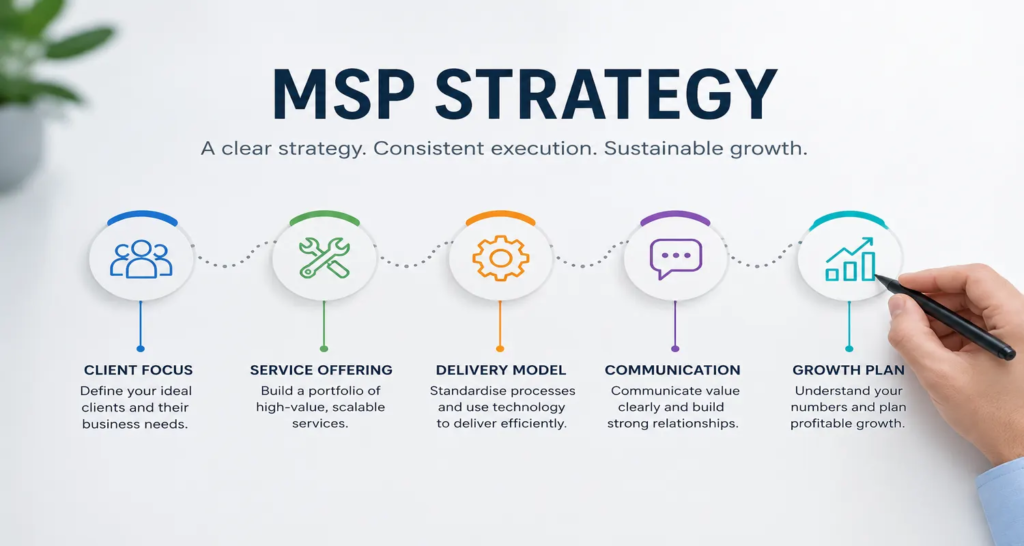
A clear MSP strategy defines the clients you want to serve, the services you provide, how you deliver them efficiently, how you communicate value, and ultimately how the business grows.
Many MSPs begin with a highly reactive model. A client has a problem, the MSP fixes it, and everyone moves on. However, as the business grows, that approach can become a constraint. Without a clear strategy, an MSP can find itself dealing with inconsistent client environments, low-margin support, unpredictable project revenue, and increasing dependence on its founders.
SecuVeo was founded by Luis Navarro following more than 15 years spent building and growing a successful MSP. As co-founder of Totality Services, Luis helped grow the company from a small team into a highly profitable MSP serving more than 150 clients, with operations in London and Johannesburg, before the business was acquired.
One of the biggest lessons from that journey was simple: clients rarely care about technology for technology’s sake. They care about what it does for their business.
A strong MSP strategy recognizes that distinction.
Key Takeaways
Standardization supports profitability. The more technology, processes, and service delivery can be standardized, the easier the MSP becomes to operate efficiently.
Make security commercially relevant. Rather than selling individual security products, explain the business risks those products address and the outcomes they provide.
Focus on client value and retention. Structured client meetings and Security Reviews help demonstrate value, identify risks, and create opportunities for strategic conversations.
Use data to make decisions. Metrics such as recurring revenue, gross margin, service delivery cost, client retention, and revenue per employee can provide a clearer picture of business performance.
Build operational maturity. As an MSP grows, it should gradually move from reactive firefighting toward proactive account management, documented processes, strategic planning, and greater management responsibility.
What Is an MSP Strategy?
An MSP strategy is a plan for how a Managed Service Provider will create value for its clients while building a profitable and sustainable business.
Technology is obviously part of that plan. However, strategy extends far beyond the tools an MSP uses.
It should consider:
- Which clients the MSP wants to serve
- Which services it will provide
- How those services will be priced
- Which technologies will form the standard stack
- How services will be delivered efficiently
- How security will be incorporated
- How clients will be managed
- How new business will be generated
- How profitability will be measured
- How the company will scale
Without that structure, growth can simply create more complexity.
With it, growth has a much better chance of creating value.
Core Components of a Successful MSP Strategy
| Strategy Element | Reactive Approach | Strategic Approach |
|---|---|---|
| Client Reviews | Occasional catch-up meetings | Structured business and Security Reviews |
| Pricing | Cost-plus or historical pricing | Pricing based on service scope, cost, value, and required margin |
| Security | Selling individual tools such as AV or MFA | Building security around risks, controls, and business outcomes |
| Sales | Depending primarily on referrals | A repeatable approach to acquisition and account growth |
| Operations | Supporting whatever each client already uses | Standardizing technologies and processes wherever practical |
The objective isn’t to eliminate flexibility. Rather, it is to prevent unnecessary exceptions from becoming the operating model.
The Foundations of MSP Business Strategy
Technical expertise is essential within an MSP, but technical expertise alone doesn’t build a successful services company.
As the business grows, commercial disciplines become increasingly important.
You need to understand pricing, margins, people, sales, client retention, operational efficiency, contracts, and risk. In addition, you need to know when a client or technology no longer fits the direction of the business.
Luis wasn’t the technical founder at Totality Services. His focus was primarily on sales, marketing, client relationships, and the commercial side of the company.
That separation proved valuable.
Highly technical teams could concentrate on delivering excellent technology, while the commercial side of the business focused on translating that expertise into something clients could understand and value.
The same principle influences SecuVeo today: great technology matters, but clients still need to understand why they should care.
Operational Standardization
Consider an MSP where every client uses a different firewall, backup platform, endpoint security product, and Microsoft 365 configuration.
Every variation increases complexity.
Engineers need knowledge across more products. Troubleshooting can take longer. Automation becomes harder. Documentation becomes more complicated, and onboarding new employees requires broader training.
Standardization can reduce that burden.
For example, defining a preferred technology stack allows the MSP to develop deeper expertise around a smaller number of products. Consequently, support becomes easier to document and automate.
Standardization can also simplify sales.
When you understand your preferred client environment, you can estimate licensing, implementation, and support requirements more consistently. As a result, pricing becomes less dependent on guesswork.
The goal isn’t necessarily to make every client identical.
Instead, create a defined standard and make exceptions deliberately rather than accidentally.
Make Security Part of Your MSP Strategy
Security is now central to the relationship between MSPs and their clients.
However, that doesn’t mean every MSP needs to become a specialist cybersecurity consultancy or build its own Security Operations Center.
It does mean cybersecurity should form part of the MSP’s overall service strategy rather than existing as a collection of optional products.
For example, an MSP might establish minimum standards around:
- Multi-Factor Authentication
- Endpoint protection
- Endpoint Detection and Response
- Email security
- Backup
- Encryption
- Patch management
- Identity security
- DNS or web protection
- Microsoft 365 security configuration
The commercial conversation then becomes much stronger.
Instead of asking:
“Would you like to buy another security product?”
the MSP can explain:
“We’ve identified a gap against the security standard we recommend for our managed clients. Here’s the risk, why it matters, and what we recommend doing about it.”
That’s a very different conversation.
Become a Business Risk Advisor
The terminology an MSP uses matters.
Technical teams naturally think in terms of vulnerabilities, alerts, configuration, patching, endpoints, and infrastructure.
Business leaders generally think about downtime, financial loss, reputation, insurance, compliance, productivity, and operational disruption.
Therefore, a mature MSP needs to translate between the two.
A firewall isn’t valuable simply because it is a firewall. Its value comes from the business risk it helps manage.
Likewise, a backup isn’t valuable because a backup job ran successfully. Its value becomes clear when the business understands how quickly important information and systems could be recovered after an incident.
That shift in communication helps position the MSP as a strategic partner rather than simply a support provider.
Advanced MSP Strategies for Growth
Once the operational foundations are in place, the next question is growth.
For many MSPs, growth immediately means acquiring more clients.
New-client acquisition is obviously important. However, it’s only one source of growth.
Your existing client base can also create significant opportunities through additional services, security improvements, projects, cloud services, consulting, and increased user counts.
Therefore, a strong MSP strategy should consider both:
New-client acquisition and existing-client development.
Strategic Account Management
Your existing clients already know your company.
You’ve built trust, understand their environment, and have access to their technology roadmap.
However, many MSPs don’t have a consistent process for identifying and communicating recommendations.
That’s where structured account management becomes valuable.
Quarterly Business Reviews (QBRs), strategic technology meetings, and Security Reviews can move the conversation beyond support tickets.
Instead of simply reporting how many tickets were closed, discuss:
- What has changed since the previous review
- Current business priorities
- Outstanding technology risks
- Security improvements
- Infrastructure lifecycle
- Upcoming projects
- Budget requirements
- Progress against previous recommendations
As a result, account management becomes proactive rather than reactive.
Pricing for Profitability
Pricing should evolve as the MSP evolves.
Labor costs change. Vendors increase prices. Clients become more complex. Security requirements expand. Meanwhile, services that were once optional can become part of the expected baseline.
Therefore, MSPs should periodically review whether their pricing still reflects the actual cost and value of the service being delivered.
Common approaches include:
Per-user pricing: Useful when service consumption broadly follows the number of people being supported.
Per-device pricing: Appropriate where endpoint or infrastructure counts are a major driver of service cost.
Tiered packages: Different service levels built around defined requirements and outcomes.
Hybrid pricing: A combination of users, devices, infrastructure, or service components.
There isn’t one pricing model that is automatically right for every MSP.
The important question is whether the model is understandable, commercially sustainable, and capable of producing the margin required to deliver a high-quality service.
Move Toward Outcomes
Clients don’t necessarily care how many technical activities an MSP performs behind the scenes.
They care about the outcome.
For example, instead of focusing only on patching activity, discuss how effective patch management reduces exposure to known vulnerabilities.
Similarly, don’t talk only about backup jobs. Discuss recovery objectives and the organization’s ability to restore critical information after an incident.
This doesn’t mean eliminating technical detail. Instead, it means connecting that detail to something commercially meaningful.
Commercializing Security Through Structured Reviews
Security Reviews can serve several purposes simultaneously.
First, they help identify weaknesses in a client’s security posture.
Second, they demonstrate the work and value provided by the MSP.
Finally, they create a structured opportunity to discuss legitimate improvements.
However, many Security Reviews become too technical.
A client may receive dozens of pages of information but still struggle to answer the most important questions:
What’s wrong?
Why does it matter?
What do you recommend?
What should we do next?
A good Security Review should make those answers clear.
The “Why It Matters” Framework
Consider MFA.
Simply telling a client that MFA should be enabled may not be enough. The client might see additional authentication as inconvenient.
Instead, explain the underlying issue.
Passwords can be stolen or compromised. MFA adds another verification step, which can make it significantly harder for someone with a stolen password to access an account.
Now the client understands why the control matters.
The same approach can be used throughout a Security Review:
- Current State: Where are we today?
- The Gap: What is missing?
- The Risk: Why does this matter to the business?
- The Recommendation: What should be done?
- The Decision: What has the client decided?
This turns a technical finding into a business conversation.
Creating Accountability
Recommendations also need outcomes.
Suppose an MSP identifies an important security gap, explains the risk, provides a recommendation, and the client decides not to proceed.
That decision should be documented.
Doing so creates a clear record of what was recommended and what the client decided at that point in time.
However, risk acknowledgement shouldn’t be treated as a substitute for appropriate contracts, insurance, professional advice, or the MSP’s own security obligations.
Its primary purpose is clarity and accountability.
Moreover, the record becomes valuable at the next review. The MSP can revisit the recommendation, explain whether the risk has changed, and ask the client to reconsider.
This structured approach to Security Reviews is one of the ideas behind SecuVeo.
Build an Investment-Ready MSP
Even if you have no plans to sell your MSP, building it as though somebody might want to acquire it can be a useful discipline.
Why?
Because many of the characteristics that can make an MSP attractive to a buyer are also characteristics of a healthy business.
For example:
- Predictable recurring revenue
- Healthy margins
- Strong client retention
- Low customer concentration
- Appropriate contracts
- Standardized service delivery
- Documented processes
- Capable management
- Limited founder dependency
Improving these areas can make the business stronger regardless of whether a transaction ever takes place.
Focus on High-Quality Recurring Revenue
Not all recurring revenue is equally attractive.
Imagine two contracts generating similar revenue. One runs efficiently on your standard technology stack, while the other generates constant support issues and requires several non-standard products.
The headline revenue may look similar.
The economics aren’t.
Therefore, your MSP strategy should consider the quality and profitability of recurring revenue, not simply the total amount.
Reduce Owner Dependency
Founder dependency creates a natural ceiling.
If the owner needs to approve every proposal, handle every important client meeting, resolve every escalation, and make every operational decision, growth will eventually become constrained.
Processes can help.
For example, standardized client reviews allow account managers to follow a consistent framework rather than relying entirely on the founder’s personal knowledge.
Likewise, documented sales, onboarding, service delivery, and escalation processes make it easier for other people to take responsibility.
Over time, the business becomes less dependent on individual personalities and more dependent on systems.
Keep an Eye on EBITDA
Revenue growth is easy to celebrate.
Profitability deserves equal attention.
EBITDA can provide a useful view of underlying operating performance, although it should be considered alongside other metrics.
For an MSP, those may include:
- Gross margin
- MRR
- Client retention
- Revenue per employee
- Service delivery cost
- Effective Hourly Rate
- Client concentration
- Sales pipeline
- Cash generation
Ultimately, strategy needs to show up in the financial performance of the business.
If revenue is growing rapidly while margins continually decline, something needs attention.
Common MSP Strategy Mistakes
Even a good strategy can fail through poor execution.
Several problems repeatedly appear as MSPs grow.
Taking On the Wrong Clients
Early-stage MSPs often accept almost any client because revenue matters.
That’s understandable.
However, as the company grows, some clients can become increasingly difficult to support because they refuse to replace outdated infrastructure, adopt basic security controls, or move toward the MSP’s standards.
At that point, the MSP has choices.
It can help the client modernize, reprice the service to reflect the additional complexity, or decide that the relationship is no longer commercially appropriate.
The important thing is to make that decision deliberately.
Over-Tooling
MSP vendors constantly release new products.
Some can create significant value. Others simply duplicate functionality already present in the stack.
Every additional tool brings licensing costs, training, management, integration, documentation, and support requirements.
Therefore, before adding another platform, ask:
What specific problem does this solve?
Will it improve service delivery?
Will it reduce risk?
Will it reduce operating cost or create additional revenue?
If the answer isn’t clear, adding another product may simply create more complexity.
Fear of Selling
MSP owners sometimes feel uncomfortable discussing additional security spending because they don’t want every client meeting to feel like a sales pitch.
That’s understandable.
However, there is an important difference between unnecessary upselling and making a professional recommendation.
If you genuinely believe a client has an important security weakness, explaining that weakness isn’t aggressive selling.
It’s part of your role as their technology advisor.
Present the risk clearly, explain your recommendation, provide the commercial information required to make a decision, and then let the client decide.
The SecuVeo Perspective: Real-World Application
SecuVeo wasn’t created from a theoretical idea of how MSPs should operate.
It came from experience building one.
During more than 15 years of growing Totality Services, one recurring challenge was taking complex technical information and turning it into something commercially meaningful for clients.
Security Reviews are a perfect example.
A client doesn’t necessarily need another 40-page technical document.
They need to understand:
Where are we now?
What are the risks?
What has changed?
What do you recommend?
What happens next?
When those questions are answered clearly, decision-making becomes easier.
Standardize the Security Review Process
If the quality and content of a Security Review depend entirely on the individual performing it, consistency becomes difficult.
One person may focus heavily on endpoint security. Another may concentrate on Microsoft 365. Someone else may emphasize backup.
A standardized framework helps ensure that important areas are reviewed consistently.
Furthermore, standardization makes it easier to train Account Managers and vCIOs, compare progress over time, and deliver a consistent experience across the client base.
This is where a platform such as SecuVeo can support the wider MSP strategy by turning Security Reviews into a structured, repeatable workflow.
Future-Proofing Your MSP Strategy
The managed-services market will continue to change.
Cybersecurity requirements are increasing. Compliance obligations are evolving. AI is changing workflows. Clients are becoming more dependent on cloud services, while insurers and other third parties increasingly influence security requirements.
Therefore, an MSP strategy can’t remain static indefinitely.
Compliance as an Opportunity
Some clients need to meet specific security or compliance requirements because of their industry, customers, contracts, insurers, or regulatory environment.
MSPs don’t necessarily need to become legal or compliance specialists.
However, understanding the technology controls associated with the sectors they serve can create additional value.
For MSPs with a strong vertical focus, this can also become a meaningful differentiator.
AI and Automation
Automation has been part of managed services for years, but AI is creating additional opportunities.
Routine administrative work, reporting, data analysis, documentation, and other repetitive tasks may increasingly be automated or accelerated.
However, the objective shouldn’t simply be to automate everything.
Use technology to reduce low-value manual work so employees have more time for activities where human judgment matters.
That might include:
- Strategic client conversations
- Complex troubleshooting
- Security recommendations
- Account management
- Consulting
- Business planning
As a result, automation can support both efficiency and a better client experience.
Frequently Asked Questions
How Often Should I Update My MSP Strategy?
A formal annual strategic review is a sensible starting point for many MSPs. However, tactical areas such as pricing, vendor performance, security requirements, and sales performance may need to be reviewed more frequently.
The important thing is to avoid creating a strategy once and then ignoring it.
What Is the Most Important KPI for an MSP Business Strategy?
There isn’t one KPI that adequately measures an MSP.
MRR tells you about recurring revenue but not necessarily profitability. EBITDA provides insight into operating performance but doesn’t explain individual client economics. Revenue per employee can indicate efficiency but needs context.
Therefore, use a combination of metrics that reflects revenue, profitability, service delivery, client retention, and growth.
Should I Hire an MSP Strategy Consultant?
An experienced outside perspective can be valuable, particularly when an MSP reaches a stage of growth its leadership team hasn’t experienced before.
However, choose carefully.
Look for someone who understands the economics and operational realities of an MSP rather than someone offering generic business advice.
How Do I Convince Clients to Pay for Security Projects?
Start by making the risk understandable.
Explain the current situation, the business impact, your recommendation, the investment required, and what could happen if the client decides not to proceed.
That creates an informed business decision rather than a purely technical discussion.
Can I Scale My MSP Without Standardizing My Stack?
Yes, but unnecessary variation generally makes scaling more difficult.
Standardization can improve training, automation, troubleshooting, documentation, procurement, and pricing.
However, the objective shouldn’t be standardization for its own sake. Maintain flexibility where a client’s genuine requirements justify it.
What Role Does SecuVeo Play in an MSP Strategy?
SecuVeo helps MSPs standardize and automate the Security Review process.
It provides a repeatable way to review security, communicate risks clearly, demonstrate value, track client decisions, and identify legitimate opportunities for security improvements.
As a result, Security Reviews can become part of the MSP’s broader account-management and growth strategy rather than an isolated technical exercise.
Is Per-User or Per-Device Pricing Better for Growth?
Neither model is automatically better.
Per-user pricing can work particularly well where users are the main driver of service consumption. Conversely, per-device pricing may be appropriate where endpoint or infrastructure counts more closely reflect the MSP’s cost.
Some providers use a hybrid approach.
The best model is the one that clients can understand and that accurately reflects the cost, scope, and value of the service being provided.
How Should I Handle a Client Who Refuses Security Recommendations?
First, make sure the recommendation and associated business risk have been explained clearly.
If the client still declines, document the recommendation and their decision through your established process.
For particularly significant risks, the MSP may also need to consider whether continuing to support the client is consistent with its contractual obligations, insurance requirements, security standards, and risk appetite.
Building a Better MSP
Ultimately, a strong MSP strategy is about creating a business that becomes more capable as it grows rather than simply more complicated.
Standardize where it makes sense. Understand your numbers. Develop your people. Build predictable sales and account-management processes. Make cybersecurity commercially understandable. Document recommendations and client decisions. Above all, make sure growth improves the quality of the business rather than simply increasing its size.
For Luis, many of these lessons came from more than 15 years of building Totality Services from a small team into a successful MSP before its acquisition.
SecuVeo takes one part of that experience and turns it into a repeatable process: helping MSPs deliver consistent Security Reviews, demonstrate value, communicate security risks clearly, and turn genuine recommendations into informed client decisions.
Technology will continue to change.
The MSPs that build strong businesses around it will be the ones best positioned to grow.